A smooth monthly close tells you almost nothing about how year-end will go. That sounds wrong, because it feels like the same job scaled up, and it is a fair assumption that a team with the month well in hand will find the year falls into place behind it. It does not always work that way. The two are different animals, and treating them as the same is how strong teams end up caught out every twelve months by problems they had good reason to think were behind them.
Here’s the difference. The monthly close is forgiving. If something slips in March, April will catch it, and the stakes of any single month are low enough that you never really have to confront the small inefficiencies you have learned to work around.
Year-end is far less forgiving. It makes you account for a whole year in one sitting, against a deadline that does not move, with auditors waiting. And the pressure is rising rather than easing: Grant Thornton notes that finance teams are getting leaner at the same time as the audit cycle is becoming more complex and more demanding, which leaves less and less room to prepare for the very thing that scrutinises the year hardest. Year-end reaches back across twelve months of decisions you always knew you might have to justify, then asks you to justify them all at once, often without the time or the tools to make that easy. Being on the back foot when the audit starts, the same firm observes, tends to mean more year-end adjustments and a string of time-consuming conversations with auditors about the quality of the data.
That is why year-end bottlenecks deserve their own conversation, separate from the usual advice about closing faster. Speed is not the problem. Depth is. The thing that bites at year-end is your ability to reach back into the year and produce, on demand, the reasoning and the figures behind decisions made months ago. You can run a tight monthly ship and still find year-end brutal, because year-end is testing something the monthly rhythm never bothers to check.
What follows are five bottlenecks that behave differently, and worse, at year-end than at any other point in the cycle. They are drawn from conversations with finance professionals across several regions about the pressures of closing the books.
1. Manual processing that compounds rather than repeats
The cost of handling invoices by hand is usually described as a recurring monthly tax, and across an ordinary month that is exactly what it is. A Financial Controller at a medical association had measured it precisely: "Each invoice approximately takes 15 to 20 minutes to process. When we scale that up, that's essentially looking at 33 hours a month in accounts payable processing time over a hundred bills. That's essentially half a working week." Half a week, month after month, is a steady and predictable drain.
What changes at year-end is that the drain stops being steady. The closing period concentrates a year's worth of loose ends into a few weeks. The invoices that were set aside, the entries that need adjusting, the accruals that have to be prepared all arrive at once, and all need the same fifteen-to-twenty-minute manual touch. The monthly tax becomes a lump sum, payable precisely when the team has the least room to absorb it. This is why manual processing that feels merely annoying in an ordinary month can become the thing that pushes a close past its deadline.
The teams that find year-end calm tend to be the ones who took the mechanical handling off people well before the deadline arrived. That way, the closing weeks are spent on judgement rather than on data entry. Automating capture and routing through a tool such as ApprovalMax is less about shaving minutes off each invoice than about ensuring the year-end lump sum never forms in the first place.
2. Approvals that live in inboxes the auditor cannot see
An approval that happened over email is, for day-to-day purposes, a perfectly real approval. The invoice was reviewed, someone replied yes, the payment went out. As one Accountant described their process: "It's all manual processing. We get an email through AP forwarded to the respective managers and they have to verify and then eventually verify and then approve, and this has to happen within three days of receiving invoice." Through the year, that works well enough.
The trouble surfaces months later, when someone has to prove that the approval happened. An email approval is only as findable as the inbox it lives in. And inboxes are private, scattered, and prone to being deleted, archived, or left behind when someone changes role. At year-end, an auditor asks to see the authorisation behind a particular payment from eight months ago, and the difference between a workflow and an email chain becomes stark. One is a record. The other is an archaeology project.
The fix is not simply to route approvals faster, but to route them somewhere durable and shared. ApprovalMax captures each authorisation as a permanent record at the moment it happens, so the approval is held in one searchable place rather than scattered across personal mailboxes that no one can reliably search a year on.
3. The exceptions that were left "for later" and never revisited
Every finance team accumulates a small pile of transactions that did not quite fit the rules. The spend that bypassed the usual sign-off, the invoice coded provisionally, the one-off arrangement that was waved through under pressure with a quiet intention to tidy it up later. In any given month these are a handful of minor irregularities, easily parked.
Year-end is where "later" finally arrives, all at once. Those parked exceptions do not resolve themselves. They sit in the ledger waiting, and the closing period is when every one of them has to be explained, justified, and squared away. Often that falls to someone reconstructing a decision they were not party to. A few exceptions a month becomes dozens by year-end, each carrying its own small mystery. What makes this bottleneck so corrosive is that it stays invisible right up until the moment it is not, because nothing forces a reckoning with these items until the books have to close.
The way to defuse it is to stop creating the backlog in the first place. ApprovalMax enforces the policy at the point of approval, so an exception either fits a defined rule or gets resolved on the spot, rather than being quietly set aside to compound into a year-end clean-up operation.
4. Commitments that arrive as invoices nobody approved
Some of the most difficult items at year-end are the costs the finance team never saw coming. Spending gets committed somewhere in the business, the invoice lands weeks later, and finance is left holding an obligation it had no hand in approving. A Financial Controller at a European manufacturing business put the frustration plainly: "When the invoices come to us, it is an expense that we already committed to pay. And sometimes it's a surprise. Where comes these 2,000 pounds? Who approved it? Well, we need to pay because we already have the invoice."
During the year these surprises are absorbed one at a time. At year-end they take on a sharper edge. Each one is a commitment that has to be accounted for in the right period, attributed to the right authority, and defended if questioned. None of that information was captured when it mattered. The result is a scramble to retrofit a justification onto a decision made informally months ago.
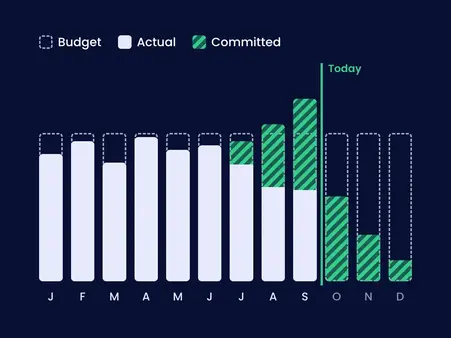
The structural answer is to move the control point ahead of the commitment rather than behind it, so that spending is approved before the obligation exists. Purchase order workflows in ApprovalMax put the checkpoint where it belongs, ahead of the spend rather than after the invoice. Year-end is then never spent explaining a cost that finance learned about only when the bill arrived.
5. The numbers as they stood on a date that has already passed
This is the bottleneck that is purely a creature of year-end, with no real equivalent in the monthly rhythm. Closing the books is not only a question of where things stand today. It is a question of where they stood on the closing date, which by the time the work is done may be weeks or months in the past. The figures have to be reconstructed with the accuracy they would have had on the day itself.
A Finance Manager at a telecommunications infrastructure business described the exact difficulty while reviewing their own setup: "We are sitting in May right now. If we want to check what was the open balance, open PO balance as of December 31st, not as of today... we would expect $60 open PO balance because 100 was the original, 40 was invoice received until December 31st. Do we have that functionality?" It is an entirely reasonable thing to need and a surprisingly common thing to lack. A system built to show the current state has no natural way to answer a question about a past one. When that capability is missing, the close turns into a manual exercise in working backwards, reverse-engineering historical balances from whatever fragments of evidence survive.
Clearing it depends on keeping a record that preserves the state of every commitment and approval over time. Then "what did this look like on the close date" becomes a question with a direct answer rather than a research project. An audit trail that captures each action as it happens does exactly that, which is much of why ApprovalMax keeps one.
What the five have in common
Read together, these five point to something more specific than "year-end is hard." They show that year-end is hard for a reason the monthly close conceals. It is the one moment that demands not just current accuracy but a retrievable account of a whole year's decisions. The monthly rhythm rewards keeping things moving. Year-end rewards having kept things recorded. Those are different disciplines, and a team can be excellent at the first while being caught out badly by the second.
Which is the real lesson buried in all five bottlenecks. None of them is solved in the closing weeks, because by then the year has already happened and the record is whatever it is. They are solved across the preceding months, in the unglamorous habit of capturing each decision cleanly at the point it is made. Do that, and when the deadline finally arrives there is nothing left to reconstruct. The close becomes what it should always have been: a confirmation of work already done, rather than the year catching up with you all at once.
That habit is precisely what ApprovalMax is built to make automatic. It routes every approval to the right person, holds spend to policy before the money is committed, and keeps a complete audit trail of who approved what and when, so the record is already there when year-end asks for it. The teams that close calmly are not working harder in the final weeks. They have simply put the groundwork in place, and the best time to do that is well before the deadline is in sight. If your last close felt like a reconstruction project, see how ApprovalMax can help you close the next one with the evidence already in hand.







 Ask Perplexity