Put a dozen finance leaders around a table, and ask them about AI. You might expect an evening of use cases and quiet FOMO. What you get instead is a long, careful conversation about everything that can go wrong.
That was the dinner ApprovalMax and Chris Ortega of Fresh FP&A hosted in Toronto this summer — no slides, no agenda, just conversation about how AI is actually landing inside finance teams. These were not the sceptics. Most of them use the tools and have firm views on them. And yet, for a room of people paying close attention to innovations in tech, they spent most of the night talking about what can often go wrong.
That turned out to be the interesting part.
AI adoption in finance teams remains cautious: Canada’s 2026 national AI strategy put business adoption near 12 percent against a 60 percent target for 2034. That caution reflects accountability, not resistance — finance leaders answer personally for the numbers. Effective adoption depends on three things: integrating tools into routine reporting rather than leaving them with a single champion, assigning an owner to unmanaged AI consumption costs, and keeping a human sign-off before any output reaches a board or customer.
Key takeaways
- AI adoption runs in three stages — introduce, implement, integrate — and tools that never reach the integration stage get written off the moment the internal champion who ran them leaves.
- AI consumption is a variable, uncapped, organisation-wide cost that usually has no owner and no forecast, yet most finance functions have no policy governing it.
- When an AI-generated report is wrong, the person who sent it owns the mistake in full — which is why a human sign-off before anything reaches a board or customer stays essential.
Caution is not the same as resistance
One number set the tone early. Canada’s national AI strategy, published this summer, put business adoption of AI at around 12 percent, and set a target of lifting it to 60 percent by 2034. Someone at the table admitted they would have guessed the current figure was three or four times higher, given how it feels from inside a tech-forward company.
12%
current Canadian business AI adoption — target: 60% by 2034 (national AI strategy, 2026)
Someone at the table admitted they would have guessed the figure was three or four times higher, given how it feels from inside a tech-forward company.
It is tempting to read a number like that as a problem to be fixed. The room read it differently. When people who work with these tools are also the most careful about relying on them, that isn't laziness. It's information. Finance leaders are cautious about AI for the same reason they are cautious about everything else that touches the numbers: they are the ones who have to answer for the result.
The tool that nobody could use
The clearest story of the night came from one leader who had watched a promising rollout quietly die.
His company had connected an AI analysis tool to their accounting system that worked well. But the knowledge of how to run it lived almost entirely with the internal expert who had championed it. When that person left, the tool went with them. It sat there, connected and paying for itself in name only, until it was written off as dead weight.
The key lesson was not “pick a better tool.” It was that adoption has three stages, and most organizations only finish two of them. You introduce the technology. You implement it. And then, in theory, you integrate it into weekly reporting, key decisions, and the way the team actually works. That third stage is the one that often gets skipped. A tool that never makes it into the routine is a tool waiting to be forgotten the moment its champion walks out the door.
The bill nobody is watching
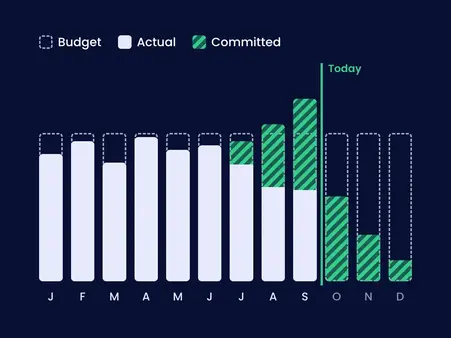
One leader raised the running cost of AI, including the tokens consumed every time someone in the business asks a model to do something, and pointed out that almost no one is managing it. There is no strategy for it. People across the organization are using these tools freely, and the bill lands at the end of the month, sometimes at what they expect, and sometimes at several times that.
For a finance function, this should feel familiar and slightly alarming. It is a variable, uncapped, organization-wide cost with no owner and no forecast. Every other line item that behaves like that eventually gets a policy wrapped around it. For many companies, AI consumption hasn’t yet. The leaders who spotted it were not against the spend. They just recognised an unmanaged cost when they saw one, which is more or less the job.
Someone still has to sign it
Running underneath every part of the conversation was a single, sobering point about accountability.
When an AI-generated report is wrong, there is no colleague to point to. You cannot say the model did it, or that a junior misread the brief. The person who sent the report owns the mistake, in front of the board, in full. That does not change because the work was automated.
So the room’s answer was not to avoid the tools. It was to keep a person in the loop who signs off before anything reaches a customer or board member. The efficiency is real, and one leader described building a report in ten minutes that used to take a junior two days. But the review step needs to remain human on purpose, because while the tool speeds up processes, the team member whose name is on the outcome is the one who knows what to review for.
What the caution is really about
Put the pieces together and a picture emerges that is more useful than “adopt faster.”
The finance leaders in that room are not evangelists and they are not refuseniks. They are treating a powerful new tool the way they treat everything else that touches the numbers. Assume the data might be wrong until you have checked it. Make sure someone owns the tool costs. And accept that a person, not a model, answers for what goes out. None of that is fear. It is the ordinary discipline that makes finance worth trusting, pointed at something new.
The teams that get real value from AI over the next few years probably will not be the ones that moved fastest. More likely they will be the ones that bothered to work it into how they actually operate, kept an eye on what it was costing them, and never lost sight of the fact that a person still signs the report.
That is not an argument for going slow. It is an argument for getting your controls in place first, so that going fast does not cost you later.
ApprovalMax hosted “Off the Books” in Toronto with Chris Ortega of Fresh FP&A, an evening of candid, peer-to-peer conversation among finance leaders. Thanks to everyone who brought their thinking to the table.
Free trial
See ApprovalMax in action
No credit card required. Works with Xero, QuickBooks Online, and NetSuite.
Start free trialBook a demo









 Ask Perplexity