Finance teams usually build budget vs actual reports from their accounting system, which records spend when the bill is entered. Spend that a budget owner has already approved on a purchase order isn’t included until then, so the report shows more budget left than is actually available. We analysed 5.3 million bills approved by more than 4,000 businesses using ApprovalMax with Xero between October 2025 and September 2026, to find out how much spend this affects and for how long. The businesses are in the UK, South Africa, Australia, New Zealand, the US and Canada.
For bills matched to a purchase order, the data records two dates: the day the purchase order was approved and the day the bill arrived. From those dates it shows how long approved spend stays out of budget vs actual reports, how often purchase orders are approved after the invoice, and how often bills come in above the approved amount.
The main finding: nearly one in five bills matched to a purchase order arrived more than two months after the order was approved. For those two months, a budget vs actual report showed that money as still available.
Key findings
- 29% of approved bill value was committed through a purchase order before the bill arrived.
- The median bill arrived 10 days after its purchase order was approved, and 19% took more than 60 days.
- In the US and Canada, the median wait was 19 days, and 28% of bills took more than 60 days.
- 26% of bills matched to a purchase order were dated before the order was approved.
- 12% of purchase orders were billed above their approved value, typically by 19%.
- 46% of businesses that check spend against budgets in ApprovalMax use a monthly check period.
Why committed spend is missing from budget vs actual
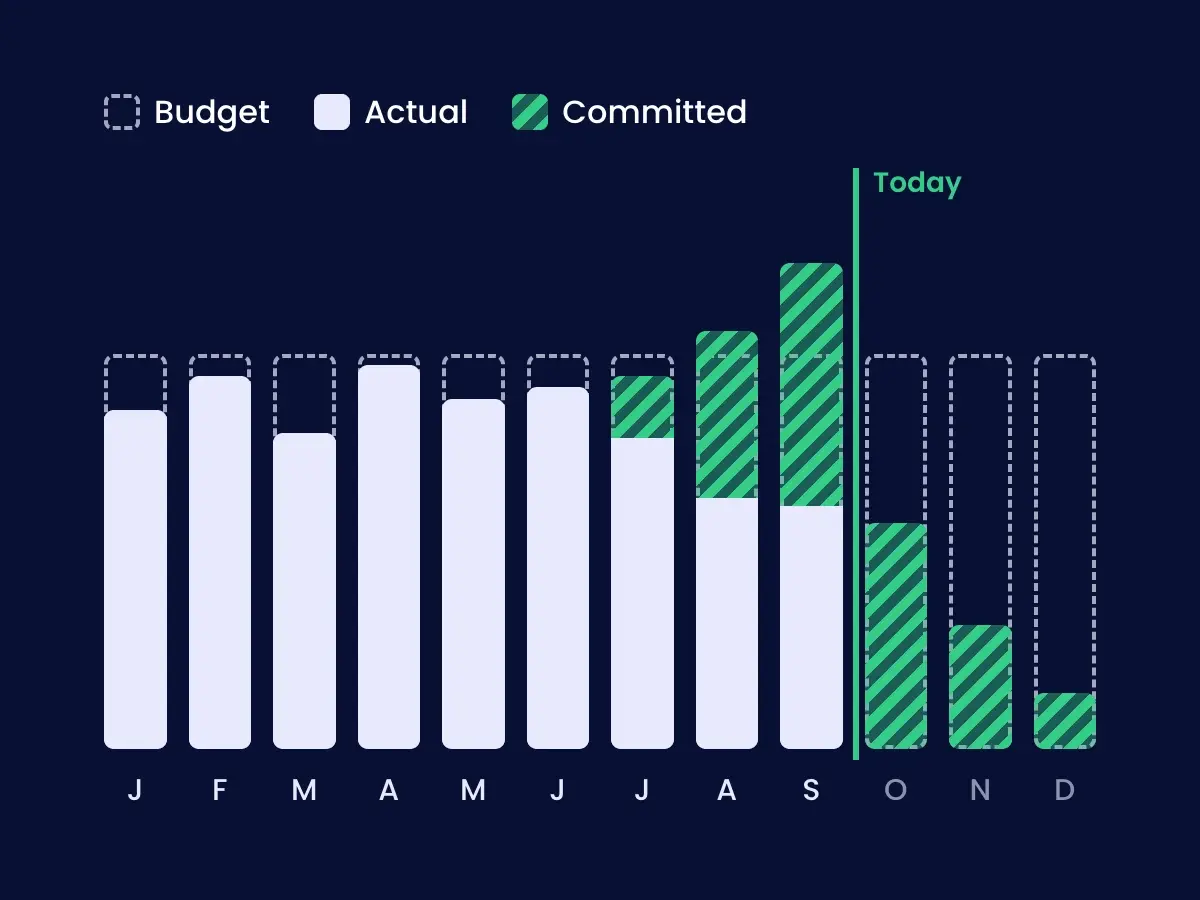
Actual spend is money already invoiced and processed. Committed spend is money the business has agreed to spend through a signed contract or an approved purchase order, before the supplier has billed for it.
Most budget vs actual reports are built from the accounting system, which records the bill. The purchase order sits outside those figures. A team can approve £40,000 of work in March and still show £40,000 of headroom on the budget line until the bill is entered.
We covered why this happens in Why budget overspend shows up too late. The data below shows how often it happens and for how long.
29% of bill value was committed before the bill arrived
Across the 5.3 million bills, 29% of approved bill value was matched to a purchase order that had been approved before the bill was entered in ApprovalMax. For that share of spend, the business agreed the cost in advance and the bill followed later.
The share was highest in the UK and South Africa, at 32%, and lowest in the US and Canada, at 23%. The full regional figures are in the table further down.
How long bills take to arrive after a purchase order is approved
The median bill was entered 10 days after its purchase order was approved. A large share took much longer.
| Time from purchase order approval to bill |
Share of bills |
| Under 7 days |
43% |
| 7 to 30 days |
28% |
| 31 to 60 days |
10% |
| More than 60 days |
19% |
About one in five bills arrived more than 60 days after the purchase order was approved. For those bills, the spend was agreed but missing from budget vs actual for at least two months. A purchase order approved in the second month of a quarter, with its bill arriving 60 days later, lands in the next quarter's figures.
1 in 5
bills arrived more than 60 days after the purchase order was approved
Among ApprovalMax customers on Xero, 19% of bills matched to a purchase order took more than two months to arrive.
The gap was wider in North America. Among customers in the US and Canada, the median wait was 19 days, and 28% of bills took more than 60 days.
How often purchase orders are approved after the invoice
A purchase order works as a budget control when it's approved before the supplier is asked for the goods or work. Among bills matched to a purchase order, about one in four (26%) carried an invoice date earlier than the date the order was approved.
26%
of bills matched to a purchase order were dated before the order was approved
For 8% of matched bills, the purchase order was approved only after the bill had been entered.
For 8% of matched bills, the purchase order was approved only after the bill had been entered in ApprovalMax. Those bills made up 12% of matched bill value, so purchase orders approved after the bill tend to be for larger amounts.
Some of the 26% will be purchase orders that were raised in time and were still waiting for sign-off when the supplier dated the invoice. A purchase order approved on the invoice date counts as approved before it. The difference between 26% and 8% suggests that many purchase orders are approved after the invoice is issued and before the bill is processed. In those cases the purchase order records a decision that had already been made.
How often bills come in above the purchase order
Of 539,048 purchase orders approved between October 2025 and March 2026, 12% were billed above their approved value. Where that happened, the typical overrun was 19%. On a £10,000 order, that's about £1,900 the budget owner didn't approve.
1 in 8
purchase orders was billed above its approved value
Where it happened, the typical overrun was 19% of the order value.
An overrun is easy to spot when the bill is matched to its purchase order. When bills are processed without that match, the extra amount is paid and shows up later as a variance in budget vs actual.
Which budget check periods businesses use
A budget check compares each new bill or purchase order with what's left in the budget for the period. Of the 1,415 businesses that checked spend against budgets in ApprovalMax with Xero during the period, 46% used a monthly check period. Annual periods were used by 37% of businesses, and year-to-date periods by 17%.
Among businesses that set a start month, January was the most common (39%), followed by July (25%). In Australia and New Zealand, where the financial year starts in July, 51% of businesses started their budget year in July.
Regional differences
| Region |
Bill value committed through a purchase order first |
Median days from approval to bill |
Bills arriving after more than 60 days |
Matched bills dated before the purchase order was approved |
| US and Canada |
23% |
19 |
28% |
28% |
| UK and South Africa |
32% |
11 |
18% |
24% |
| Australia and New Zealand |
27% |
10 |
20% |
25% |
| All customers on Xero |
29% |
10 |
19% |
26% |
Bills in the US and Canada took almost twice as long to arrive as in the other regions, and a larger share of purchase orders there was approved after the invoice date.
What this means for budget vs actual reporting
A budget vs actual report that includes committed spend shows the position on the day a purchase is approved. Finance teams can get there by recording approved purchase orders against the budget line and matching each bill to its order when it arrives. Matching also catches the one in eight orders that are billed above their approved value.
The purchase order also needs to come first. When a quarter of purchase order-backed bills are dated before the order was approved, the order is recording spend after the decision has been made. A rule that purchase orders are approved before an order is placed, with any exceptions followed up, keeps the commitment visible from the start.
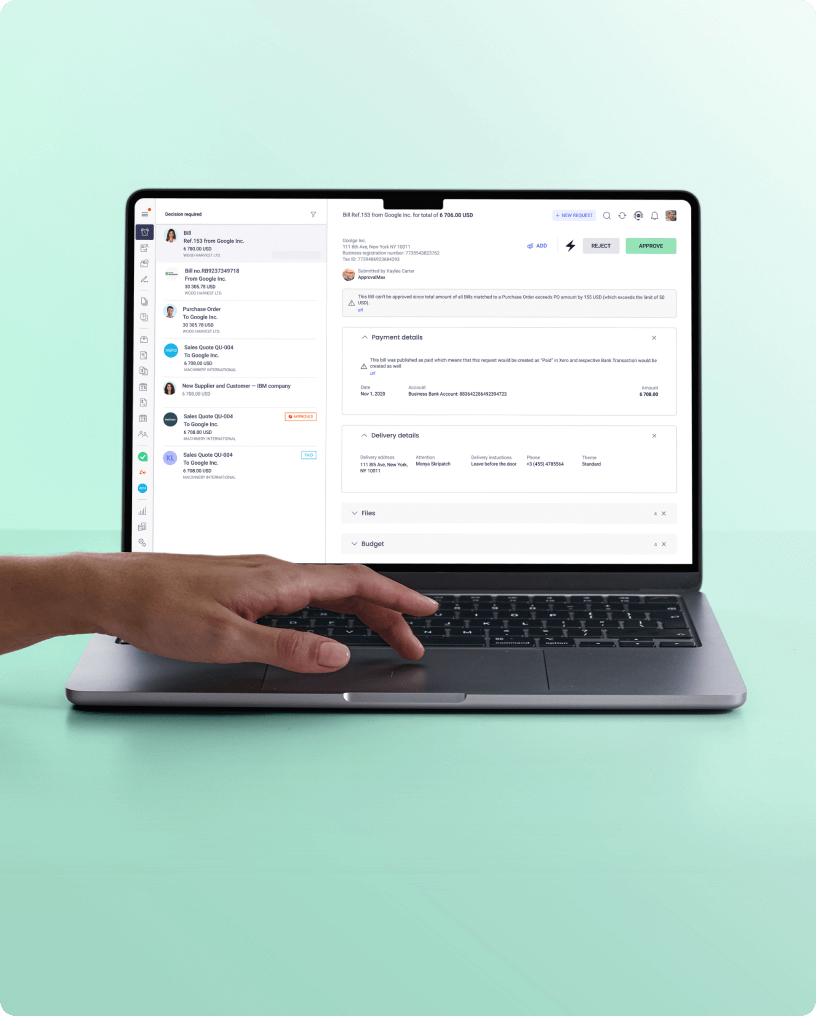
In ApprovalMax, Budget Checking for Xero counts approved purchase orders, and those still on approval, alongside bills when it checks a new request against the budget. The approver sees the effect on the budget line before they approve.
For a step-by-step plan, the guide How to hold your budget all year turns these findings into controls and a checklist for finance teams.
Free trial
See how ApprovalMax enforces approval controls automatically
No credit card required. Works with Xero, QuickBooks Online and NetSuite.
Start free trialBook a demo
Frequently asked questions
What is committed spend?
Committed spend is money a business has agreed to spend, through a signed contract or an approved purchase order, that hasn't been invoiced yet. Budget vs actual reports built only from bills leave it out.
How long after a purchase order is approved does the bill arrive?
Among ApprovalMax customers on Xero, the median bill was entered 10 days after its purchase order was approved, and 19% took more than 60 days. In the US and Canada, the median was 19 days.
What is a retrospective purchase order?
A retrospective purchase order is raised or approved after the supplier has invoiced. Among ApprovalMax customers on Xero who match bills to purchase orders, 26% of bills were dated before their purchase order was approved, and for 8% the order was approved after the bill had been entered.
How often do bills exceed the purchase order amount?
12% of purchase orders approved by ApprovalMax customers on Xero between October 2025 and March 2026 were billed above their approved value. The typical overrun was 19%.
About the data
ApprovalMax analysed anonymised, aggregated data from organisations using ApprovalMax with Xero, covering bills approved between 1 October 2025 and 30 September 2026. The share of bill value committed through a purchase order is based on 5.3 million approved bills from 4,230 organisations that match bills to purchase orders. The share of bills dated or entered before their purchase order was approved is based on 1.6 million bills from 4,259 organisations, counting only bills matched to a single purchase order; a purchase order approved on the same day as the invoice date counts as approved before it. Timing figures are based on the 1.5 million of those bills whose purchase order was approved before the bill was entered, from 4,153 organisations. Unless stated otherwise, a bill is treated as arriving when it was entered in ApprovalMax. US and Canada figures are based on a smaller group of around 110 organisations.
Bill values include tax and were converted to GBP at European Central Bank rates of 30 September 2026. To stop a handful of exceptionally large bills from skewing the results, each bill's value was capped at the 99.9th percentile (£372k). Purchase order overrun figures cover 539,048 purchase orders approved between October 2025 and March 2026 and all bills matched to them to date. An overrun is counted when bills exceed the purchase order value by at least 1%, and the typical overrun is the median. Budget settings cover the 1,415 organisations that used budgets during the period. Percentages and days are rounded to whole numbers.
You're welcome to use these figures with a link to this page. Please cite: ApprovalMax, Budget vs actual: what 5.3 million bills show about committed spend, October 2026.






 Ask Perplexity