
Most finance teams, when they decide to get serious about outgoing spend, start with AP automation.

This makes sense. When the invoices are piling up, the approval emails are going unanswered, and the month-end close is taking far too long, automating accounts payable feels like the obvious fix.

Spend management sits in a similar space. It promises visibility and control over outgoing spend - covering everything from procurement and purchasing decisions to how money moves through the business. For a CFO trying to get a handle on where money is going, it looks like a natural answer.

Both tools are used to try and solve the same underlying problem: money leaving the business without enough control over it. But they're solving different parts of that problem. Treating them as interchangeable - or assuming one covers what the other doesn't - is exactly how financial risk slips through.

The terminology trap

Before we get into why, it's worth understanding what these terms actually mean - because many finance teams use them interchangeably, even though they serve very different purposes.

AP automation is focused on the invoice lifecycle. It digitizes how invoices are received, matched, approved, and paid. Done well, it dramatically reduces manual work - according to APQC, AP automation delivers 50–70% labor time savings per invoice - and it gives finance teams faster, more accurate payment runs.

Not all AP automation solutions are designed the same way. Many traditional or invoice-focused tools prioritize processing efficiency, while more advanced solutions extend into approval governance and financial control.

Spend management sits in a similar space. It gives businesses visibility over outgoing spend - purchasing decisions, discretionary costs, company card usage. For a CFO trying to get a handle on where money is going, it looks like a natural answer.

There’s a critical difference: spend management starts before the invoice exists. AP automation starts when the invoice arrives.

The gap is the problem.

What basic AP automation misses

When a business implements basic or invoice-focused AP automation, it's aiming to increase speed and accuracy at the back end of the spend cycle. What these tools often don't cover is structured approval governance - the controls that sit between an invoice arriving and money leaving the business.

Without that governance layer, the invoice lifecycle looks like this: a department head commits to a new software subscription. A project manager brings in a new contractor. Someone renews a vendor contract without checking whether a better deal is available. By the time finance sees any of this, the commitment has already been made. The invoice is a formality. The money is already spoken for.

And even once the invoice arrives, many AP automation tools don't ask the harder questions: was this spend authorized by the right person, at the right level, against the right budget? It processes. It doesn't govern.

This is what uncontrolled spending looks like in practice: budget owners who have no idea what's been spent, finance teams playing email tag instead of doing actual financial work, and employees genuinely confused about who's allowed to approve what.

The gap isn't in automation itself. It's in what the automation is built to do - and invoice processing tools alone weren’t designed to enforce approval governance.

Closing that gap requires an additional layer focused specifically on approval workflows, accountability, and financial control across the business.

The real cost of the gap

The consequences of treating AP automation as a complete spend solution show up in ways that are hard to ignore.

When invoice data is captured inconsistently or approvals remain fragmented, finance teams struggle to assemble a unified picture of spend, accruals, and supplier activity. This reduces forecasting accuracy and makes it difficult to identify anomalies early. At worst, this leaves AP departments "flying blind," with poor visibility and data silos making cash forecasting and strategic decision-making almost impossible.

The scale of the manual burden is significant too. In one 2025 survey, 63% of finance professionals said they spend more than 10 hours per week on manual invoice and spend-related tasks - time that could be directed toward forecasting, analysis, and planning.

So, it creates substantial inefficiency, but there's a more fundamental risk: a business can have its AP perfectly automated and still have no idea whether its spending is under control. Revenue can mask this for a while - but in this scenario, when the scale of the problem is realized, the money coming in may be no match for the black hole that an ungoverned Money Out process has created.

In a nutshell, this is what happened with Peloton's reversal between 2021 and 2022. At its peak, the company had strong demand, a loyal customer base, and revenues that looked impressive on paper. But it had also been scaling its spending at a pace that assumed the growth would never stop. When demand normalized, the spending commitments didn't. The result was a crisis that required emergency cost-cutting, a CEO change, and a stock price that fell more than 90% from its peak. Invoice automation alone wouldn't have saved it. Peloton was missing governance over the spending decisions being made long before any invoice arrived.

Where the Money Out framework comes in

This is the gap the Money Out framework is designed to close.

Money Out is the complete lifecycle of how money leaves a business - from the first spend request to final payment. It treats outgoing spend not as an operational process to be managed inside finance, but as a governance discipline that runs across the whole organization.

That means five connected stages: request, approval, payment, reconciliation, and audit - each one controlled, visible, and accountable.

AP automation and spend management both play important roles within that lifecycle. But neither one covers the whole thing.

Basic AP automation tools typically handle invoice processing and payment execution, while spend management adds visibility earlier in the process.

Approval-driven control layers ensure that every spend decision is properly reviewed, authorized, and aligned with budgets before and during that lifecycle.

Money Out is the framework that connects them - and fills in the gaps.

For finance teams, this distinction matters. It shifts the question from "have we automated our invoices?" to "do we have control over every decision that sends money out of this business?" Those are very different questions, but only one of them leads to real financial governance.
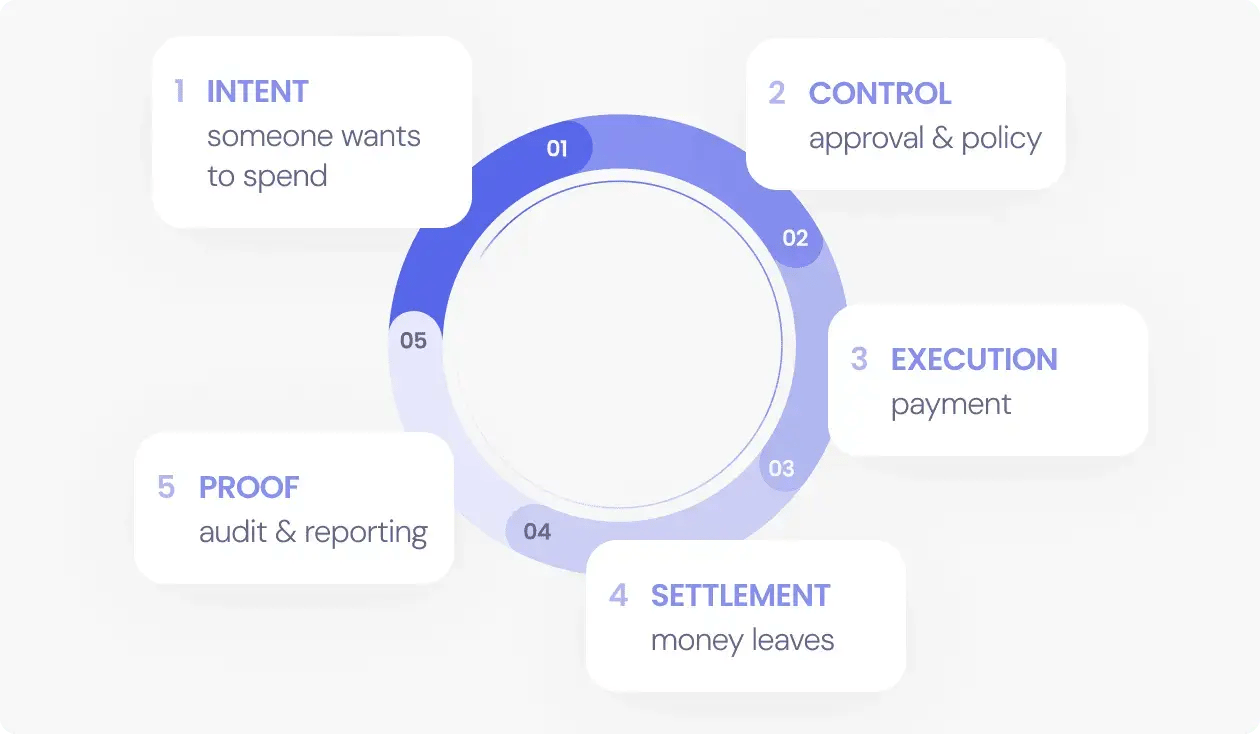
The Money Out lifecycle

What a strong Money Out process looks like

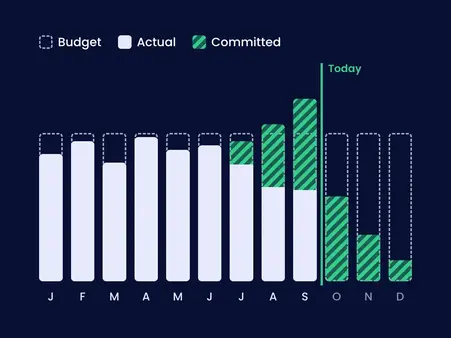
A finance team operating with a full Money Out approach not only processes invoices faster, but knows what's been committed before the invoice arrives. It has real-time visibility into budgets across every department. It has approval workflows that are structured, consistent, and auditable. And if something looks wrong, there's a complete trail to investigate.

This process isn’t about slowing spending down - it's about creating guardrails that allow the business to move faster with confidence, knowing that every outgoing decision is intentional and controlled.

Yes, AP automation is a valuable part of that. But it's a part. Not the whole.

How ApprovalMax can help

ApprovalMax helps finance teams implement structured approval workflows and financial controls across the entire Money Out lifecycle - not just at the point of payment. Book a demo with ApprovalMax or test it out with a free 14-day trial today.


Register to attend