Business growth is great. However, when transaction volumes increase, and headcount is flat, it’s Accounts Payable that feels it first.

Early signs will be the surge in approval admin - invoices, POs and bills are up. So are purchasing decisions and approval delays. Money’s coming in, morale is high, departments are growing - but your finance team - still the same small but nimble team - is expected to keep everything moving forward seamlessly.

So what happens when business is doing well? Paradoxically, your team will start to struggle. Cracks will soon start showing as processes built for a certain level of work groan under the weight of a much heavier load. With your team working longer hours, the instinct is to hire. Bring a junior in to manage the chase or an AP coordinator to focus on the backlog.

At this point, it’s important to be aware: this isn't a people problem. Adding an extra body to your team is like putting a bucket under a leaking pipe. The bucket helps - until it doesn’t. It's a process problem and one that tends to get worse, not better.

Why is the approval process the first to break?

Out of all the many processes that take place in the finance department - why is the approval process the first to fall apart during periods of growth?

When a company is small, informal approval works fine. A manager gives the nod, an invoice gets paid, business moves on. Nobody requires “a system” because everyone can see what's happening.

But by its very nature, growth changes that. Add departments, budget owners, and bigger transaction values, and your informal system quickly has too many moving parts to track. The finance team becomes the connective tissue holding it all together: forwarding requests, chasing sign-offs, and manually checking whether that invoice nobody knows about actually went through the right process.

This is the point where teams hit what looks like a capacity problem, but is actually a control problem. What's needed isn't another hire, it’s a system that enforces this process automatically - and takes the onus off the team.

What "keeping control" actually means at scale

When a finance team talks about losing control as a business grows, they’re usually experiencing one of three things:

1
They can't see what's pending

Approvals are sitting in someone's inbox. Nobody knows if a payment is held up because the approver is on annual leave, didn't see the email, or is waiting for more information. The only way to find out is to ask - which means more chasing.

2
They can't stop the wrong things getting through

Without enforcement, policy compliance depends on people following rules voluntarily. When invoice volume is high and budgets are tight, the gaps show up: duplicate payments, invoices coded to the wrong cost centre, spend that wasn't properly authorised before the work started.

3
They can't prove what happened

When an auditor asks to see the approval trail for a set of transactions, the answer shouldn't be "let me search my emails from October." But for most teams still running approvals manually, that's exactly what it is.

Scaling a business without a dedicated approval layer means all three of these problems get worse in proportion to the growth. And the more transactions there are, the more gaps appear.

Accounts Payable
Why growing businesses chose ApprovalMax to help close the gap - without adding headcount

ApprovalMax sits between your accounting platform - Xero, QuickBooks Online, or NetSuite - and every outgoing payment. It doesn't replace your ERP. It doesn't handle payments. It handles the approval governance layer that sits between invoice receipt and payment execution: the part that's currently being held together with email threads and good intentions.

When finance teams integrate their GL with ApprovalMax, a number of things happen:

1

Approvals route themselves

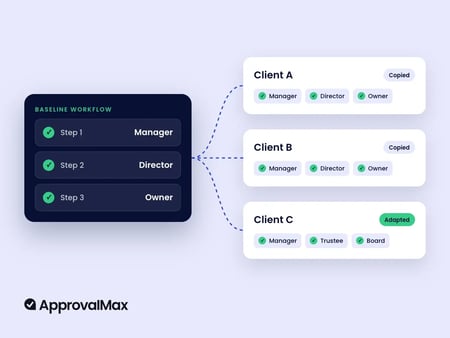
When an invoice or purchase order enters the system, ApprovalMax routes it automatically to the correct approvers - based on the rules you've set. Amount, vendor, department, cost centre, entity: any combination works. No manual forwarding. No judgement calls about who should see what.

If an approver is unavailable, auto-substitution keeps things moving. Month-end close doesn't stall because someone's travelling.

2

Approvers don't need to log in to a new system

This matters more than it sounds. One of the reasons approval processes break down at scale is that the people doing the approving - department heads, directors, VPs - aren't finance users. If they need a new login, a new app, and a new password to approve a purchase order, they'll find a workaround. Usually Slack or WhatsApp.

ApprovalMax lets approvers act directly from an email notification or their mobile device. There’s no portal, onboarding, or security issues.

3

Budget checking happens before approval, not after

Rather than discovering an overspend during month-end reconciliation, ApprovalMax surfaces live budget impact at the point of decision. The approver can see, before they sign off, whether the spend fits within the available budget. Overspend is prevented rather than explained.

4

The audit trail builds itself

Every approval generates an immutable, time-stamped record: who approved, what they saw, what comments were added, and when each step happened. There's no manual compilation, no archaeological email retrieval. When an auditor asks, the answer is ready.

5

The system scales as the business does

Start with a simple single-step workflow for a small team and add sophistication - multi-step approvals, additional entities, multi-currency support - when the business requires it. Approvers don't need Xero or QuickBooks Online licences, which means extending governance across the business doesn't mean inflating your software costs.

Topic62

What this looks like in practice

BMI Group, a Canadian real estate development company running QuickBooks Online with 50+ employees, moved from email-based approvals to ApprovalMax and saved the equivalent of 2 full-time employees per month. Each of the 15 people involved in approvals saved 16 hours a month - time previously lost to chasing and managing approvals over email.

Before implementation, only 50% of purchases at BMI Group followed the correct approval process. After, it was 100% - without adding headcount or changing their accounting platform.

"The implementation was so straightforward that we were using ApprovalMax within days of signing up."

Fil Marinkovic, CFO, BMI Group

Every month that passes without a proper approval layer is a month where duplicate payments might not get caught, where spend might not be coded correctly, where an audit request might require days of manual reconstruction. The cost of getting this wrong - in time, in errors, and in audit risk - compounds quietly.

An approval system that routes, enforces, and records automatically doesn't add to the finance team's workload. It removes the part of the workload that shouldn't be theirs in the first place.

Want to see how ApprovalMax works with your stack? We offer a free 14-day trial so you can do exactly that. Head here now.

Register to attend