

For many growing companies, QuickBooks Online works perfectly - until it doesn’t. But it’s not the software that’s broken. It’s the spend control.

When a company grows, so do its purchasing decisions. Those processes that worked in the first growth stage can quickly run out of control as the business scales.

In those first scrappy stages of business, verbal approvals, Slack messages, and OKs via email act as sufficient proof of approval for the finance department. But add more people - and more financial decisions - they soon become invisible liabilities inside QBO.

We hear from finance teams in this situation every day, that are not just facing a heavier, more complicated workload, but also opening up their business to financial risk by not changing the processes to match the size of the company.

From our conversations with real finance leaders evaluating their processes, loss of control in QBO usually comes down to the following five structural gaps.

At-a-glance tips for getting control back in QBO

• Get pre-spend visibility – see commitments before invoices hit QBO.

• Centralize approval trails – capture every decision inside a single system.

• Enforce role-based approvals – avoid “all-or-nothing” access tradeoffs.

• Give managers budget context – ensure approvals align with real-time spend.

• Automate segregation of duties – prevent one person from creating, approving, and paying.

• Reduce manual middleman tasks – let approvals flow without Finance chasing every bill.

• Tie every approval back to QBO – maintain a clean, audit-ready record.

• Prevent shadow approvals – stop critical decisions from happening in Slack or email.

• Act proactively, not reactively – control spend before it becomes a liability.

• Keep growth from outpacing control – match workflows to company scale.

1

The “post-facto” visibility gap

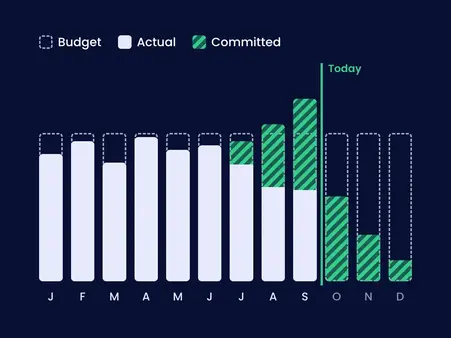
In a standard QBO workflow, Finance often sees spend after the commitment is made - when the bill arrives or the payment has already gone out.

While that’s manageable at a small scale, at growth stage, it can get very risky.

The scaling problem:
As teams expand, so does the volume of surprise invoices. Finance becomes reactive instead of preventative.

“I’m essentially a historian, not a controller. By the time I see the invoice in QuickBooks, the commitment is made and the budget is already blown.”
— CFO, North America

When the finance team only sees visibility after the fact, QBO primarily serves as a record-keeping tool rather than a real-time control system.

2

Audit trails fracture outside QBO

QuickBooks Online has a basic audit log. But what it doesn’t capture is the decision-making context: who approved something, why they approved it, and under what authority.

The scaling problem:
Approvals happen everywhere except QBO - Slack, email, hallway conversations. As the organization grows, these shadow trails become impossible to reconstruct.

“We spent 40 hours last month just digging through old emails to prove to our auditors that the CEO actually approved a specific $10k software contract.”
— Financial Controller, EMEA

When approvals live outside the system of record, audits can feel like an archeological dig.

slice 3
3

The “all-or-nothing” access risk

QBO’s permission structure forces a tradeoff that most businesses find uncomfortable, and are often required to choose to either:

  • Give department heads broad system access
  • Or keep approvals centralized in Finance

Most finance leaders choose the second, more efficient, security-conscious option.

The scaling problem:
To avoid creating control and security vulnerabilities, Finance becomes the manual middleman - downloading invoices, forwarding PDFs, chasing approvals, and marking bills approved themselves.

“I don’t want my Marketing Manager seeing payroll or sensitive data, but I need them to approve their own vendor bills. Right now, I’m the middleman for every single transaction.”
— Finance Manager, APAC

This slows things down and it also gradually erodes accountability - approvals over time stop becoming a business responsibility, to falling more heavily on the Finance team.

4

Budget blindness at the moment of approval

In growing companies, responsibility for budgets often spreads quickly to more team leaders and department heads, but visibility into actual spending and financial status doesn’t always keep pace.

The scaling problem:
QBO stores budgets in one place and bills in another. When managers approve spend, they often have no real-time context on what’s left.

“Our department heads are approving spend in a vacuum. They don’t realize they’re over budget until I send the month-end reports - and at that point, it’s too late.”
— CFO, AMER

Approvals without budget context are approvals without control.

5

No enforced segregation of duties

Expanding as a business forces a shift away from trust-based processes. For example, as more people join the organisation, it should never allow one person to create, approve, and pay a bill.

The scaling problem:
Manual workflows rely on good intentions. As volume increases, shortcuts creep in: rubber-stamping, skipped approvals, or worse.

“As we added more entities and offices, the risk of someone paying a fake invoice increased. We need a system that makes it impossible to bypass the approval rules.”
— Group Controller, EMEA

While QBO provides accurate record-keeping and real-time reporting, without enforced workflows it can’t stop transactions that go against company policy.

two people walking through a busy finance office

Why this isn’t a QuickBooks problem

It's important to stress that QuickBooks Online is doing what it was designed to do: accurate accounting.

What growing companies need - and what QBO doesn’t provide natively - is:

  • Pre-spend visibility
  • Structured, role-based approvals
  • Budget awareness at decision time
  • A complete, centralized approval audit trail

Without that layer, growth will always outpace control.

How growing companies regain control (without replacing QBO)

A lack of control in finance isn’t a limitation of QBO, it’s a signal that better systems and workflows are needed. The companies that fix this issue aren't ripping out their GL and starting again. They overcome it simply by introducing systems that:

  • Capture approvals before spend happens
  • Enforce approval rules automatically
  • Let managers approve without exposing sensitive data
  • Tie every decision back to QBO with a clean audit trail

The result is finance teams that stop acting like historians, and seize this new-found control, visibility and governance to start acting like controllers again.

How ApprovalMax can help

ApprovalMax sits on top of QuickBooks Online, adding the control QBO alone can’t provide.

It gives finance teams pre-spend visibility, automated, role-based approvals, budget awareness at decision time, and a complete audit trail - all without replacing your existing accounting system.

The result: fewer surprises, faster approvals, and finance teams that regain control and confidence as your company grows.

Find out for yourself - book a demo today.

Register to attend