
It’s Friday afternoon. The invoice from your largest supplier has been sitting in Xero for three days, approved by the right person, and ready to move to payment. What happens next is where the process falls apart.

You export the supplier information from Xero into a spreadsheet. You log into the bank portal. You find the supplier. You type in the amount. You cross-reference the invoice. You do this twelve more times. An hour later, you send the spreadsheet summary to your CFO over email, who replies “ok” from their phone. The payment runs.

Nobody saw the actual invoices, just the amounts. Nobody can, without significant effort, prove what was approved versus what was paid.

Your approval process worked perfectly, but the payment process is a different story.

Why control breaks down at payment

This back-and-forth manual task is not a one-off. It happens on the next Friday and the Friday after that. A loop that just keeps running and drains a little more of your energy every time.

The reason it keeps happening is not a lack of effort; it's because the approval process and the payment process are two separate worlds. Once a bill moves to "Awaiting Payment", the governance that existed during approval simply doesn't follow it. There's no link between what was approved and what's about to leave the account. The spreadsheet, the bank portal, the email to the CFO, none of it is connected to the approval trail that came before it.

That's the control gap. It doesn't appear because the process is badly run. It exists because there's no structure designed to close it.

The true cost of manual payments

A manual payment run isn’t just inefficient. It introduces risks that shouldn’t exist in a governed workflow.

Xero Use case (1)

If a payment is ever questioned by an auditor or the board, a spreadsheet and an email thread are scraps, not an audit trail. A complete, unbroken record from approval to payment is what holds up.

What a controlled payment process actually looks like

The finance teams who’ve fixed this describe the same outcome. In their words, the payment process becomes quiet.

  • The payment run happens on schedule. Nobody is chasing sign-off over email
  • The CFO or director who authorises payments sees the actual invoices, not just a summary, and approves with full context
  • Nobody enters supplier bank details manually into a portal
  • When a payment is questioned, the answer is immediate with a single timestamped record from invoice approval to payment, no email archaeology required
  • The finance team’s Friday afternoon is spent on strategic finance work, not the payment run.

How ApprovalMax closes the gap end-to-end

Switching from a manual payment process to a fully controlled one is simpler than it sounds. It requires a solution that ensures every approved bill gets paid in the same place it was approved. No switching tabs, no exporting files, no separate system. The approval trail follows the bill all the way to the bank, with every step connected and every decision on record. That's what ApprovalMax Pay is built for.

With ApprovalMax Pay, here’s what your Friday afternoon looks like:

Finance teams who've made the switch describe the experience as less hassle and more control:

“ApprovalMax Pay is incredibly useful for us! It simplifies payments through secure batch processing, saving time on tracking and approvals. Having everything in one app reduces hassle and enhances security, making it easier than manual bank payments.”

Finance manager, UK real estate company

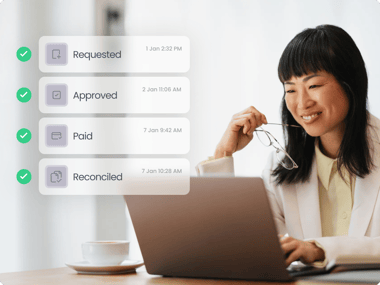
With ApprovalMax Pay, the record from invoice submission to payment is what an auditor sees when they ask how a payment was authorised. It's what your CFO uses to show the board exactly what was approved and what was paid, in one place, on demand.  And it’s what your finance team never has to reconstruct from email threads again.

Register to attend