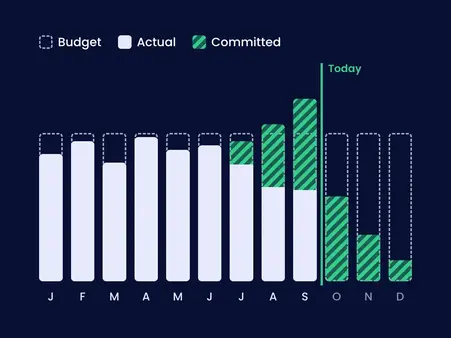
• Why it matters: Slow AP approvals don’t just delay payments. They break visibility into committed spend. When finance can’t see what project teams have already approved on site, job cost data becomes unreliable, lien protections weaken, and subcontractors lose confidence in your payment process. 

  • The bottom line: Construction margins aren’t disappearing because there’s less work. They’re disappearing in the gap between field approvals and financial visibility. Closing the gap with structured, automated approvals gives finance teams control over spend before it hits the ledger.

There’s a big problem with construction in 2026. Money is being lost - not through lack of work, or competition but on a much more granular level. Margins are shrinking because businesses can’t see the money that’s already left the building.

The problem lies in that moment between the project manager saying yes to a subcontractor onsite, and the finance team seeing the invoice that came from that ‘yes’. This scenario might seem fairly harmless, but what happens in that space - often called the Commitment Gap - is where huge problems can creep in.

Where the problem lies

We speak to companies in the North American construction industry a lot. One CFO from a Texas-based general contractor recently told us:

"I don't mind paying bills. What keeps me up at 3:00 AM is the bill I haven't seen yet. If my PMs are approving spend via text message or 'verbal OKs,' my budget reports aren't reality. They're just a guess."

This sums up the issue. The budget report is essentially meaningless if you don’t have visibility on spend. It’s all just a guess.

That’s because somewhere between your team on site and your ledger in the office, spend is happening that your finance team cannot see. Your PM is approving things on calls, verbal exchanges on-site, invoices lying in trucks. This disconnect can cost more than you think.

And when that visibility disappears, the consequences show up everywhere - in legal protection, in the accuracy of your job cost data, and in the way subcontractors choose who they work with.

The lien waiver liability risk

When your approval process is slow, things start eroding the safety of the traditional process. In order to keep the project moving, people start cutting corners. In one common scenario, a sub needs to get paid but the waiver isn't in yet. Someone makes a pragmatic call: pay now, get the waiver later.

This is what opens up the business to a huge vulnerability.

The thing about lien waivers is that they're not paperwork. They're the legal instrument that protects your right to a clean title. If you miss enough of them and you're not running behind on admin, you're handing subcontractors a legal claim against the property.

Late approvals aren’t just about amassing a late fee. They can create a legal risk.

How to fix it: ApprovalMax builds "No Waiver, No Approval" gates directly into the approval workflow. The invoice cannot move forward until the waiver is attached. This means that there’s no manual chasing for your finance team, but also no exceptions to the rule. The process enforces it automatically.

construction for approvalmax

The 'invoice in the truck' risk

If there’s one quotation that sums up this specific issue, it’s from a call from a site supervisor at a mid-market residential builder.

"I'm not an accountant, I'm a foreman. If I'm doing paperwork, I'm not building. So the invoices sit in the glovebox until I need to clean the truck."

This is not a laziness problem. This is about this person’s particular priorities.

The problem lies in what happens next. According to our data, construction firms without mobile approval workflows see an average 10 to 14-day lag between an invoice being issued and it reaching the finance office. By the time the invoice lands on someone's desk, the credit hold threat is already live. And when that happens, the priority shifts from accuracy to velocity. Get it processed, get it paid, move on.

So who actually assigns the cost codes? Returning to the data we hold, in 45% of audited manual workflows, it's AP staff in the office. People who have never set foot on the site. Not the PM who knows exactly what phase the work belongs to.

The phase gets guessed. The cost code gets approximated. Costs for Phase A end up attributed to Phase B. The GL entry goes in wrong. And now your business’s job cost reports are fiction.

And it can get worse, because the damage isn't just in this project, it's in the next bid. Your estimator looks at the historical data, sees that item appears to come in under budget last year, and bids more aggressively on the next job. Except it didn't actually come in under budget. The costs were just miscoded.

You win a project that's mathematically impossible to complete profitably.

Data from our research suggests 25% of construction companies face bankruptcy after just two or three wrong estimates. Bad data doesn't just create unreliable reporting. It leads to bids being made that you can't survive winning.

How to fix it: ApprovalMax Capture lets a foreman photograph an invoice on site the moment it's handed over. The OCR technology reads the document and extracts the key details automatically. That invoice then immediately kicks off the approval workflow, routing it to the PM who actually knows which phase the work belongs to, while the job is still fresh in their head.

Rather than an invoice spending two weeks in a truck before landing on an AP staffer's desk for a best guess at the cost code, the foreman photographs it on site, Capture reads the details automatically, and the PM confirms the right phase and code on mobile the same day.

The subcontractor risk

US construction is facing a 350,000-worker shortage in 2026. The dynamic has shifted significantly. Subcontractors aren't competing for work in the way they once were. Increasingly, they're choosing who they work with and cash flow predictability is one of the primary factors driving that decision.

CFOs on ApprovalMax’s recent discovery calls reported that their biggest risk to project schedules isn't material delays anymore. It's subcontractor no-shows. A sub waiting 30 days for payment from one GC will consistently prioritize the job site of another who runs an automated net-7 or net-10 payment cycle.

The email-based approval chain makes this harder to fix than most finance teams realize. When invoices get lost in back-office threads, subcontractors lose visibility into their own cash flow. When that happens, they either price the uncertainty into their next bid - effectively charging you for the friction your process creates - or they quietly stop bidding altogether.

One Controller described it this way on a recent call: "We lost our preferred electrician to a competitor not because of the hourly rate, but because our approval process was so broken they couldn't project their own cash flow."

Most of the time, you never find out why a sub moved on. The calls just stop coming.

The underlying issue is idle time, not processing time. Invoices aren't slow because they're complicated to handle. They're slow because it isn't clear who's responsible for them. When an approval request gets sent to a thread with three people cc'd, everyone assumes someone else is dealing with it. Two weeks pass before anyone acts.

How to fix it: ApprovalMax removes that ambiguity by routing every invoice to the right approver automatically. Ownership is defined by the workflow, not by whoever happens to check their inbox first. Approval cycles that used to run 15 days compress to 24 hours - and that reliability is what keeps your best subcontractors coming back.

Why...-3

No more AP archaeology

There's a phrase that captures exactly what broken AP looks like. Email archaeology.

That's what you're doing when you dig through reply chains and forwarded threads just to figure out if someone actually approved something. It's reactive. It's slow. And it's completely backwards.

BMI Group, a Canadian real estate development and construction company, lived this. Approvals managed entirely through email, across multiple project entities. Things got lost. Work sometimes had to start before sign-off was formally obtained. Sound familiar?

After switching to ApprovalMax with QuickBooks Online, they saved the equivalent of two full-time employees per month and an estimated CAD $200k per year. Approval compliance went from 50% to 100%.

That's what happens when you stop doing archaeology and start building architecture.

AP shouldn't be a documentation exercise that happens after the money moves. It should be the financial architecture of the project. The layer that makes every committed dollar visible before it's spent, coded correctly when it's approved, and traceable instantly when someone asks about it.

The Commitment Gap is not inevitable. It's just what happens when you run a 2026 construction business on a 2005 approval process.

How ApprovalMax can help

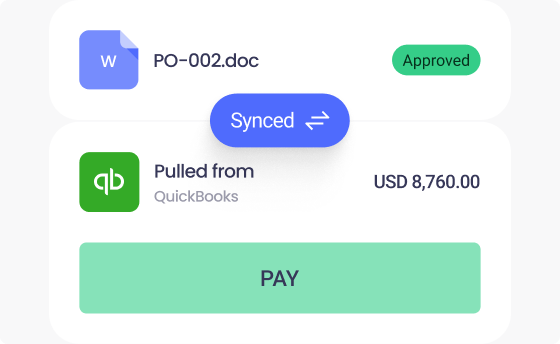
ApprovalMax integrates directly with QuickBooks Online to bring automated approval workflows, real-time budget visibility, and audit-ready records to construction finance teams. If your AP process still lives in email threads and text messages, it's time to close the gap. Start a free trial today.


Register to attend