E-invoicing in the UK becomes mandatory on 1 April 2029. From that date, every VAT-registered business must be able to receive e-invoices. It must also send its VAT invoices as e-invoices whenever the customer is VAT-registered too. An e-invoice is structured data that the customer’s software can read directly, so a PDF sent by email will no longer count. HMRC published its implementation roadmap on 28 October 2026, and the detailed rules are due between October 2027 and April 2028. Countries in Europe that have already made this change show that the hardest part for businesses is usually the quality of their existing invoice data. The technology itself has caused fewer problems.
The UK e-invoicing mandate at a glance
- Who it affects: every VAT-registered business, sole trader, partnership, charity and public body in the UK, and overseas businesses registered for UK VAT.
- When: 1 April 2029. The roadmap gives the same date to businesses of every size.
- What changes: VAT invoices to VAT-registered customers must be sent and received as structured e-invoices. PDFs, Word documents and scanned paper invoices will not meet the rules.
- What is not included: sales to consumers, sales to customers who are not VAT-registered, and sales to customers outside the UK.
- Where things stand: HMRC published its implementation roadmap on 28 October 2026. The detailed rules and technical standards are due between October 2027 and April 2028.
- Countries already doing it: Italy since 2019, Germany (receiving) since 2025, Poland since February 2026 and France since September 2026.
- What a business can do now: clean up supplier and customer records, check what its accounting software provider plans, and review how bills are approved.
Why UK businesses should look at Europe now
From 1 April 2029, every VAT invoice a UK business sends to another VAT-registered business or to a public body will have to be an e-invoice. The government confirmed this at the Autumn Budget on 26 November 2025. On 28 October 2026, HMRC and the Department for Business and Trade published an implementation roadmap. It sets out who is in scope and when each part of the rules will be published.
So UK finance teams now know the date, who is covered and the timetable. What they don’t have yet is the technical detail, which is due between October 2027 and April 2028. While they wait for it, several European countries are already a few years down the road. Italy has run mandatory e-invoicing since 2019. Germany, France and Poland are rolling it out now, with mixed results.
This piece looks at what happened in those four countries, what the UK has already decided, and what UK businesses are likely to find difficult. The UK will design its own system, so none of this is a forecast. But the problems other countries have hit so far are consistent enough that they are worth knowing about while the UK rules are being written.
What is e-invoicing, and does a PDF invoice count?
An e-invoice is an invoice sent as structured data that one piece of software can read directly into another, with no person typing anything in. A PDF emailed to a customer does not count, even though most people would call it an electronic invoice. Under the 2029 rules, PDFs, Word files, HTML invoices and scanned images are all outside the definition.
The difference matters because a PDF still has to be opened, read and entered into the buyer's accounts system, either by a person or by scanning software that guesses at the contents. With a true e-invoice, the supplier's system sends the figures, VAT, dates and references as data fields. The buyer's system receives them as data fields. Nobody retypes anything.
Many UK businesses will be surprised by this. If you raise invoices in Xero or QuickBooks and email them out, it is easy to assume you are already most of the way there. In most cases you are not.
UK e-invoicing legislation: what HMRC’s October 2026 roadmap confirmed
HMRC and the Department for Business and Trade ran a consultation on e-invoicing in 2025. The government confirmed the start date at the November 2025 Budget, chose a network in June 2026, and published its implementation roadmap at the Budget on 28 October 2026. These are the main points for businesses.
- Start date. From 1 April 2029, VAT-registered businesses and public bodies must be able to receive e-invoices. They must also issue their VAT invoices as e-invoices. The roadmap gives the same date to businesses of every size.
- Who is in scope. The rules apply wherever a VAT invoice is needed today. That is when a VAT-registered business sells to another VAT-registered business in the UK. It includes sole traders, partnerships, charities and public bodies that are registered for VAT. Overseas businesses registered for UK VAT follow the same rules as UK businesses.
- What is out of scope. Sales to consumers, and to businesses that are not VAT-registered, do not need a VAT invoice. So they do not need an e-invoice. Sales to customers outside the UK are also outside the rules. Any business can still choose to send e-invoices for these sales, including businesses that are not VAT-registered.
- Exemptions. These will be narrow. HMRC is designing an exemption for people who cannot reasonably use software, for example because of their age, a disability or where they live. It will follow the same approach as the existing Making Tax Digital exemption. Details of how to apply are due by April 2028.
- The network. On 23 June 2026, HM Treasury and HMRC confirmed that Peppol will be the core network. Peppol is an international set of rules for sending invoices between different software systems. Businesses connect through a certified provider called an access point. For most small businesses, that will be their accounting software provider or a partner it works with. HMRC will take over the running of Peppol in the UK from NHS Supply Chain. It has said it will not receive copies of business invoices in that role.
- Penalties. HMRC plans to base these on the existing penalties for VAT invoice errors. Full details are due by April 2028.
- No live reporting to HMRC at the start. The 2029 rules cover invoices passing between businesses. But on Budget day HMRC opened a consultation on whether invoice data could also be reported to it in future. The consultation closes on 20 January 2027, and the government says no decision has been made.
- Older electronic systems. Some businesses already exchange invoices through electronic data interchange (EDI), which uses direct links set up with large customers or suppliers. They can keep using EDI, but they will also need to be able to send and receive e-invoices through Peppol. Guidance is due in autumn 2027.
The UK e-invoicing timeline
| When |
What happens |
| 28 October 2026 to 20 January 2027 |
Consultation on whether invoice data could be reported to HMRC |
| Spring 2027 |
Public consultation on technical standards and on how access points will be certified. The law giving HMRC the power to require e-invoicing is expected to pass |
| Autumn 2027 |
Guidance for businesses that use EDI |
| End of 2027 |
Guidance for specific groups, such as people who may need an exemption |
| October 2027 to April 2028 |
Full rules published, including scope, exemptions, technical standards, business identifiers and rules for software providers |
| By April 2028 |
Updated VAT guidance, details of taxpayer duties and penalties, and how to apply for an exemption |
| From about April 2028 |
Government advertising campaign begins |
| Summer to winter 2028 |
Software providers test their systems and connect to the UK network |
| 1 April 2029 |
E-invoicing becomes mandatory |
The government says it does not plan to change the requirements after April 2028. That gives businesses and software providers at least 12 months with fixed rules. The formal regulations may not finish going through Parliament until autumn 2028 or early 2029. HMRC has said it will announce its decisions as it makes them, so businesses can keep preparing in the meantime.
Some points are still undecided. These include the identifier that will be used to address invoices to each business, such as a VAT number or company number. The exact technical standards are also undecided, and so are the rules for VAT groups and self-billing.
E-invoicing in Italy: seven years of results from the first full mandate in the EU
Italy made e-invoicing compulsory for all domestic sales between businesses, and to consumers, on 1 January 2019. It was the first EU country to do so. Public-sector suppliers had already been using it since 2014.
Italy uses a central model. Every invoice goes to a government platform, the Sistema di Interscambio, which checks it and then passes it on to the customer. The UK has chosen a different model, where invoices pass between businesses through private providers and HMRC does not approve each one. So the Italian system is not a template for the UK. Its results are still the clearest evidence of what e-invoicing does once it is running.
The early numbers were strong. In the first half of 2019, 97% of invoices were cleared without problems, across 890 million invoices. By mid-March 2019, the authorities had already found €688 million in fraudulent VAT credits.
The longer-term effect has been studied independently. A peer-reviewed study in International Tax and Public Finance estimated that e-invoicing cut Italy's losses from cross-border VAT fraud by between €2.2 billion and €2.6 billion from 2018 to 2019. That is close to the Italian finance ministry's own estimate of a €1.7 billion to €2.1 billion rise in VAT revenue. The same study notes that Italy still detected around €1 billion of cross-border fraud in 2019 and 2020. So the fraud figures went down, but some fraud carried on through the new system.
What UK businesses can take from Italy: the system works at national scale, and most invoices go through cleanly once people are used to it. But a structured invoice can still be a fraudulent one, so checks on who is being paid, and why, are still needed.
€2.2–2.6bn
cut in Italy's cross-border VAT fraud losses, 2018–2019
Estimated in a peer-reviewed study in International Tax and Public Finance. Around €1 billion of cross-border fraud was still detected in 2019 and 2020.
E-invoicing in France: two years of delays, then a difficult first month
France is the most useful comparison for the UK because, like the UK, it uses a network of private providers rather than one government platform. It is also the most recent. France's mandate was originally set for July 2024 and was postponed and redesigned before it finally went live on 1 September 2026.
From that date, every VAT-registered business in France must be able to receive e-invoices, and large and mid-sized companies must also send them. Small businesses and micro-businesses start sending in September 2027.
How ready French businesses said they were, compared with how ready they turned out to be
In June 2025, a survey of 206 finance and project leaders at large and mid-sized French companies found that 80% were confident they would meet the September 2026 deadline. A year later the picture was patchier. As of June 2026, only 21 accredited platforms were actively sending invoices, and around a quarter of France's largest billers had still not chosen a platform. The government kept the date but paused penalties until the end of 2026, an approach one briefing described as a delay in all but name.
The first three weeks in numbers
The French authorities have published operating data for the first weeks, summarised by vatcalc.com:
- On 10 September, the central portal received 924,040 invoice files. 402,423 of them failed checks, a rejection rate of 43.5%.
- Around 32% of the failed files were missing required information. Other failures came from wrong formats, company ID numbers missing from the national directory, and VAT figures that did not add up.
- Between 18 and 20 September, 142,923 files were rejected. Most came from one provider that had set up its system wrongly.
- By 21 September, 63% of large companies and 41% of mid-sized companies had sent at least one e-invoice. Most providers were passing more than 90% of invoices by then.
The main finding from France is that most failures did not start with the new technology. They started with the customer and supplier records already sitting in businesses' accounting systems. For years, an invoice with a wrong company number or a missing field would still reach the customer and still get paid. Under e-invoicing, the software checks every field and rejects the invoice if something is missing.
What UK businesses can take from France: a business that says it is ready may not be. The work that takes longest is cleaning up supplier and customer records, and that can start now, before the UK publishes its standards.
43.5%
of invoice files rejected in France on 10 September 2026
402,423 of 924,040 files failed checks, most often because required information was missing from existing records (vatcalc.com).
E-invoicing in Germany: receiving first, sending later, with the timing set by turnover
Germany has split the change into stages. Since 1 January 2025, every business must be able to receive e-invoices from other German businesses. Sending them becomes compulsory on 1 January 2027 for businesses with more than €800,000 turnover in the previous year, and on 1 January 2028 for everyone else. Businesses already exchanging invoices through older electronic data interchange (EDI) systems can carry on with them until the end of 2027.
The logic is sensible. A business cannot send an e-invoice to a customer whose system cannot take it in, so Germany made sure the receiving side was in place first. Larger businesses, which usually have more resources, then go before smaller ones. It also means German businesses have had three years to learn the system as receivers before they have to use it as senders.
What UK businesses can take from Germany: the UK has made a different choice. Its roadmap gives every VAT-registered business the same date, 1 April 2029, for both sending and receiving, whatever its size. That means UK businesses won’t get a period of learning the system as receivers before they have to send. The preparation German businesses spread over three years will need to be done before the start date. On EDI, the UK has gone further than Germany. Businesses can keep their EDI links after 2029, as long as they can also exchange e-invoices through Peppol.
E-invoicing in Poland (KSeF): what happened when the government's own system was not ready
Poland's national e-invoicing system, KSeF, was due to become mandatory in July 2024. That date was moved to February 2026 after an IT audit found critical flaws in the system's performance. The finance ministry rebuilt the system with outside IT architects, appointed a chief engineer, and committed to testing every stage. It also acknowledged that many companies had already spent significant money preparing for the original date.
The mandate finally started on 1 February 2026 for the largest taxpayers and 1 April 2026 for most others. Even then, the ministry confirmed that penalties for errors would not apply until 1 January 2027, giving businesses most of a year to make mistakes without being fined.
What UK businesses can take from Poland: dates can move, and they can move late. Polish businesses that prepared for July 2024 spent money against a date that then moved by 19 months. Work that improves invoice data and approval processes is useful whatever date the UK finally sets, so it is not wasted if the timetable changes. The UK government has said it does not plan to change its requirements after April 2028, although the formal regulations may still be going through Parliament until early 2029.
Where UK businesses are starting from, and what they are likely to find hard
HMRC has researched how small and medium-sized businesses use e-invoicing today. As reported by Saffery, it found:
- About 59% of SMEs say they are familiar with e-invoicing, but only 29% use it, and just 10% both send and receive e-invoices.
- Around 40% were unaware of the coming changes, and more than 90% had not seen any HMRC communication about them.
- The most common way of invoicing, by a wide margin, is still a PDF sent by email, followed by paper.
- Almost all SMEs already use accounting software.
That last point is the good news. Most of the UK's small businesses already run their invoicing through software such as Xero or QuickBooks, so the tools to send and receive e-invoices are likely to come through their existing providers. The harder work is everything around the software.
Likely problems, based on what other countries have seen
Customer and supplier records. France's rejection data shows that missing fields, wrong company numbers and inconsistent VAT details cause most failures. In the UK, the same records have often built up over years, with duplicate suppliers, old addresses and missing VAT numbers. Fixing them is slow work, but it is something every business can start on without waiting for HMRC.
Receiving, not just sending. Most of the attention goes to sending invoices. But a business will also need to receive e-invoices from every supplier who is required to send them, and route them to the right person for approval. A finance team that currently forwards PDFs around by email will need a new way of doing that.
Exceptions. Credit notes, disputed invoices, partial deliveries and duplicates do not go away under e-invoicing. Saffery's advice is to plan for these exceptions specifically, even if more than 90% of invoices go through without a problem.
Cost and training. KPMG lists software and training costs, integration with existing systems and security risks as the main drawbacks businesses will need to weigh.
Fraud. Fraudsters already target businesses by posing as suppliers and asking them to change bank details. In the first half of 2024, invoice and mandate scams of this kind caused £25.7 million of losses, 78% of it on business accounts, according to UK Finance. The government’s roadmap says e-invoicing will make it easier for software to compare the bank details on an invoice with the details that supplier used before. That check helps. But it relies on the supplier record being right in the first place. If a fraudster has already changed a supplier’s bank details in the accounting system, the invoice format won’t stop the payment.
Why HMRC wants this
HMRC's latest figures put the UK tax gap, the difference between tax owed and tax collected, at £59.2 billion, or 6.4% of tax due, for 2024 to 2025. VAT makes up 20% of that gap, and small businesses account for the largest share of the total. The UK's VAT gap has already fallen a long way, from 13.8% in 2005 to 2006 to 5.0% in 2023 to 2024. E-invoicing is one of the tools HMRC is using to close what is left. The Treasury expects e-invoicing to raise £10 million in 2027 to 2028, rising to £160 million in 2030 to 2031.
Benefits of e-invoicing for UK businesses
The mandate is a tax measure, but most of the day-to-day benefit goes to the businesses sending and receiving invoices.
Lower processing costs. Research by Sage, which HMRC cited in its consultation response, found that a typical small business could save around £11,000 a year by adopting e-invoicing. Tradeshift puts the cost of processing an e-invoice at 38% of the cost of a paper invoice and 43% of the cost of a PDF.
Less retyping and fewer errors. When invoice data arrives as data, nobody has to key it in, so there are fewer typing mistakes and fewer invoices sent back for correction.
Faster payment. KPMG expects e-invoicing to lead to faster payments and fewer opportunities for human error and fraud. Invoices that arrive complete and in a format the customer's system accepts are quicker to approve. The government’s roadmap says late payments cost the UK economy £11 billion a year. It also cites NHS Shared Business Services, which reports that e-invoices are paid 26 days faster on average than paper or emailed invoices.
Fewer disputes. Saffery points out that structured invoices can improve matching accuracy, reduce disputes and speed up approvals, although it also notes that the full size of these benefits has not yet been proven in the UK.
Where ApprovalMax fits
ApprovalMax is not an e-invoicing provider. It does not send invoices over the Peppol network, and businesses will not need it to comply with the 2029 rules. The compliance part will come from accounting software and certified access point providers.
Where ApprovalMax helps is the step after an invoice arrives and before it is paid. An e-invoice carries the amount a supplier wants to be paid, but it cannot show whether anyone in your business agreed to the purchase or whether the bank details are the ones you expect. Those are the questions an approval process answers.
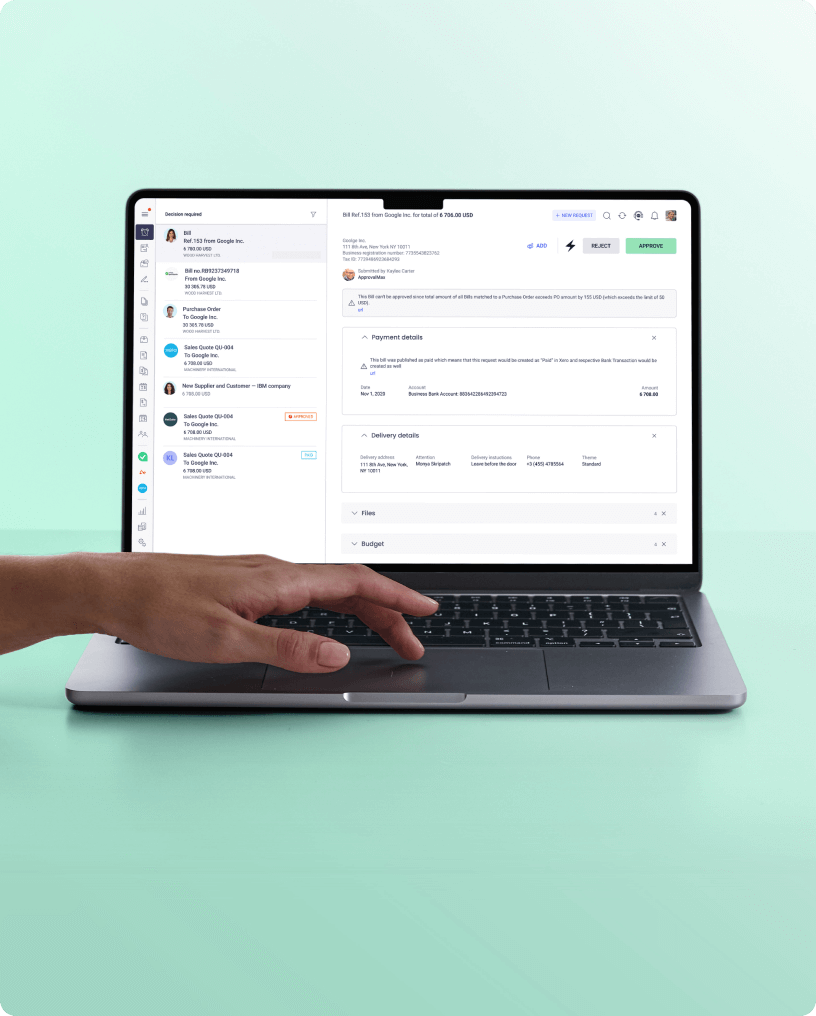
ApprovalMax works with Xero, QuickBooks Online and NetSuite. When a bill lands in the accounting system, ApprovalMax sends it to the right people to approve, following rules the business sets, such as amount limits or cost centres. Every decision is recorded with who approved it and when.
That matters more under e-invoicing, for two reasons. First, invoices will arrive faster and in larger numbers, so a business that currently approves bills by forwarding emails will need something more organised. Second, as Italy's figures show, a correctly formatted invoice can still be a fraudulent one. A clear approval trail is one of the ways a business checks that what it pays is what it agreed to buy.
£25.7m
lost to UK invoice and mandate scams, H1 2024
78% of the losses were on business accounts, according to UK Finance. A change to a supplier's bank details is not stopped by the invoice format.
So while you prepare your data and your software for 2029, it is worth reviewing how bills get approved once they arrive. That part of the process is yours to design, whatever the final UK rules say.
If you are an accountant advising clients, read our guide for practices.
E-invoicing FAQs for UK businesses
What is e-invoicing?
E-invoicing is sending and receiving invoices as structured data that accounting software can read directly, without anyone typing figures in. Under the UK rules starting in April 2029, the invoice data passes from the supplier's system to the customer's system through a network of certified providers.
Is a PDF invoice an e-invoice?
No. A PDF emailed to a customer is digital, but it is not an e-invoice under the UK rules. PDFs, Word files, HTML invoices and scanned images are all excluded, because a person or scanning software still has to read them and enter the details.
Has the UK published its e-invoicing roadmap?
Yes. HMRC and the Department for Business and Trade published it on 28 October 2026. It confirms 1 April 2029 as the start date and sets out who is in scope. It also gives a timetable for the detailed rules, which are due between October 2027 and April 2028.
Will UK e-invoicing be phased in by business size?
The roadmap does not set different dates for different sizes of business. All VAT-registered businesses must be able to send and receive e-invoices from 1 April 2029, unless an exemption applies.
Will HMRC see my invoices?
Not under the 2029 rules. Invoices pass between businesses’ software providers over Peppol. HMRC has said it will not receive copies of invoices in its role running Peppol in the UK. It is consulting until 20 January 2027 on whether invoice data could be reported to it in future, and has not made a decision.
What are the benefits of e-invoicing for businesses?
The main benefits are lower processing costs, fewer typing errors, faster payment and fewer disputes. Research by Sage, cited by HMRC, estimated that a typical small business could save around £11,000 a year by adopting e-invoicing.
Which European countries already have mandatory e-invoicing?
Italy has required e-invoicing between businesses since January 2019. Germany has required businesses to be able to receive e-invoices since January 2025, with sending phased in from 2027. Poland started in February 2026 and France in September 2026.
What went wrong when France introduced e-invoicing?
In its first weeks, many French invoices were rejected for missing information, wrong company numbers or VAT figures that did not add up. On 10 September 2026, 43.5% of invoices sent to the central portal failed checks. Most problems came from customer and supplier records in businesses' own systems.
What is KSeF?
KSeF is Poland's national e-invoicing system. It was due to become mandatory in July 2024, but an IT audit found critical flaws and the start was moved to February 2026. Penalties for errors do not apply until January 2027.
Does e-invoicing stop invoice fraud?
It reduces some kinds of fraud but does not remove it. In Italy, e-invoicing cut cross-border VAT fraud by an estimated €2.2 billion to €2.6 billion in its first year, yet around €1 billion of fraud was still detected in 2019 and 2020. Businesses still need checks on who they are paying and why.
How can a business prepare for e-invoicing before 2029?
HMRC says there is no need to start setting up e-invoicing before the detailed rules are published between October 2027 and April 2028. You can still start by cleaning up supplier and customer records, including VAT numbers and company details. Then ask your accounting software provider how it will support e-invoicing, and review how bills are received, approved and paid.
Watch our webinar with Azets on preparing for UK e-invoicing
ApprovalMax and Azets ran a webinar with ICAEW on 14 October 2026. Lee Beaumont, UK Head of Outsourcing at Azets, and Rafaella Torres, Corporate Financial Controller at ApprovalMax, explained what e-invoicing is and what is changing. They also covered what it means for approving invoices before they are paid. The session was recorded before the roadmap was published, so please use the timeline above for the latest dates. We answered the questions attendees asked in UK e-invoicing questions: Peppol, HMRC and who is in scope.
Watch the webinar on demand
Sources
Free trial
See how ApprovalMax enforces approval controls automatically
No credit card required. Works with Xero, QuickBooks Online and NetSuite.
Start free trialBook a demo






 Ask Perplexity