A client's office manager goes on leave, and somebody there asks whether your team could pay a few suppliers until they're back. Four bills. You say yes, partly because it's four bills and partly because it's an awkward favour to turn down.
By the following spring you're running that client's whole payables cycle, and two more clients have asked for the same help. Anyone who's ever given a colleague one lift to the station knows how this goes. None of it is in the engagement letter. None of it is on the fee note either.
Outsourced accounts payable is a service where your firm handles invoice capture, coding, matching and approval administration for a client, while the client keeps control of spending decisions and payment authorisation.
You're probably doing most of that already, for at least one client, without calling it anything. What's missing is everything around it: scope, who holds approval authority, the setup you reuse for every new client, and the thing that makes the fee move. Get those wrong and it's the fifth client that hurts, not the first.
Key takeaways
- Outsourced accounts payable works best when the accounting firm runs invoice capture, coding, matching and approval administration while the client keeps every spending decision and payment authorisation — a clean split between administration and authority.
- Client advisory services practices reported median growth of 17% and median net client fees per professional of $156,250, according to the 2024 CPA.com and AICPA PCPS benchmark survey of more than 200 US firms.
- Pricing an AP service works better on invoice volume, entity count, approval layers, PO coverage and exception rate than on a guess at hours worked.
What is outsourced accounts payable for accounting firms?
Outsourced accounts payable is an arrangement where an accounting firm captures, codes, matches and administers approvals for a client's invoices, while the client retains every spending decision and payment authorisation. Firms offering this as a formal service report median growth of 17% and net client fees per professional of $156,250 (CPA.com & AICPA PCPS, 2024). The strongest setups separate invoice administration from approval authority, price by invoice volume and exception rate rather than hours, and document a signed approval matrix before onboarding a new client.
Outsourced accounts payable is the arrangement where an accounting firm takes over a client's day-to-day payables work: capturing invoices, coding them, matching them, and running the approval process. The client still decides what gets bought, and the client still authorises payment.
Two similar terms sit either side of that deal.
Accounts payable outsourcing is the client's decision to hand the work to somebody else. Our guide to accounts payable outsourcing covers that side of it.
AP as a service is what you build to meet the demand: the scope, the price, and the way your team runs the same work across several businesses at once.
Three things need to exist on paper before you can run this past one or two clients: who does what, an approval matrix for each client, and a short list of numbers showing how much work each account creates.
Why build AP as a proper service?
Because unscoped work is unpriced work, and it sits inside the bookkeeping fee until somebody finally notices.
There is real money in naming it. The 2024 CPA.com and AICPA PCPS Client Advisory Services Benchmark Survey polled more than 200 US firms using 2023 data. Those practices reported median growth of 17%, median net client fees per professional of $156,250, and median revenue 61% higher than in the 2022 survey.
17%
median growth reported by client advisory services practices, 2024 CPA.com & AICPA PCPS survey
The same survey of 200+ US firms found median net client fees per professional of $156,250, and median revenue 61% higher than in the 2022 survey.
Client advisory services, or CAS, covers everything from transactional bookkeeping through controllership and advisory work. Payables sits at the operational end of that range.
Payables suits a monthly fee for two plain reasons. The work comes back every month, and nearly all of it can be counted.
It also puts your team next to what the client is actually spending. You see the new supplier, the rising subscription, the invoice that arrives twice, months before anyone asks your opinion on cash flow.
What does the service include, and what stays with the client?
Your firm runs the day-to-day AP work. The client keeps the spending decisions.
Settle that split before the first client goes live. That split sets the fee and it sets the controls. It also decides how much your team can handle before somebody has to ring the client.
| Activity |
Firm |
Client |
| Capturing, coding and matching invoices |
Runs it |
Forwards anything that arrives directly |
| Setting the approval matrix |
Advises and configures it |
Owns it and signs it off |
| Approving spending |
Not in the standard model |
Approves by named approver and limit |
| Approving a new supplier and its bank details |
Prepares and verifies |
Gives final approval |
| Chasing approvers, posting bills, preparing the payment run |
Runs it |
Names a backup approver |
| Releasing payment |
Only under a separate written mandate |
Authorises payment |
| Keeping approval records and source documents |
Holds them during the engagement |
Can view them and remains responsible for retention |
Two rows in that table cause nearly all the argument: approving spending and releasing payment.
Who should approve invoices when a firm runs AP?
We would leave invoice approval with the client, in almost every case.
Approving a bill answers two questions. Was this spending authorised, and did the goods or services turn up as agreed? Only the client's budget holder can answer the second one.
You can't know whether an £8,000 agency invoice matches the work that was delivered. Their marketing manager can. And if the invoice is wrong and your firm approved it, your name is on the decision.
Client-side approval buys the client something too. Budget holders see the cost while there is still time to query it, rather than meeting it in a management report five weeks later.
Can an accounting firm release payments for a client?
Yes, and plenty of firms do, particularly for small businesses and single-director companies.
Treat it as a separate piece of the service, with a written mandate and tighter controls. Payment release is where the money actually leaves.
The risk isn't that approval and payment both sit inside one firm. Finance teams handle both every day. The risk is one person approving a cost and releasing the payment with nobody else looking.
If your firm takes payment release on:
- Different people prepare and release payments.
- Supplier bank detail changes are checked by somebody outside that pair.
- The arrangement is written plainly enough that a stranger to the client can follow it a year later.
- The fee reflects the extra work and the extra responsibility.
Check your professional body's rules and your insurer's position before you accept payment authority. Requirements vary by country and by licence.
Four situations to settle before they happen
The approver is away and an urgent invoice lands. Name a backup approver on the client side and put them in the engagement documentation. Then use the backup. Urgency should never be the thing that decides who can approve.
A supplier changes its bank details. Your team can prepare the change and verify it by ringing a number you already hold on file. The client approves it.
Rent, utilities and other predictable costs. These can be approved automatically inside agreed limits, as long as the client signed the rule off first.
The client asks your firm to release payments. Move it onto the separate mandate above before it drifts into the standard service.
Our delegation of authority policy guide covers how to document approval levels without producing a policy nobody reads.
How do you onboard a client onto the service?
Seven steps, in this order. Authority first, software second, because setting up a workflow before the client has agreed who approves what means building it twice.
- Write down what happens now. Ask who approves what, at which values, and what happens when that person is away. The answers are usually less consistent than the client thinks they are, which is worth noting down as you go.
- Agree the approval matrix and get it signed off. Roles, categories, value bands, exceptions, backups. It is the client's policy, and the signature gives both sides a record of what was agreed.
- Write down what your firm will and will not do. Start from the table above. If you will approve spending or release money for this client, write the exception down with the controls around it.
- Measure the current workload. Count last quarter's invoices, suppliers and entities. Record PO coverage, meaning the share of spend backed by a purchase order, and count how many invoices arrive needing a fix. Those four numbers are your pricing baseline and your review baseline.
- Agree how invoices reach your team. Supplier email to a capture address, client forwarding, portal downloads. Pick two or three routes and hold the line. Accepting invoices through whatever channel suits the sender that day is how you lose them.
- Start every client from the same base setup. Change the approval matrix, the supplier coding rules and the ledger connection. Leave everything else alone.
- Run the old and new process together for a month. Log the differences before you switch the old one off. You lose a little margin that month, and you find broken approval routes while both systems are still standing, which is much cheaper than finding them afterwards.
Review the account at 60 days. Exception rate is usually the number that tells you first whether the work is heavier than you priced.
How should you price an AP service?
Price the things that change how much work the client creates, not the hours you think it will take.
Hourly, fixed fee and hybrid can all work. Most of the damage comes later: you agree a price at 300 invoices a month, then leave it untouched when the client reaches 700.
Six inputs do most of the work.
- Invoice volume. How many bills arrive each month?
- Number of entities. Every separate company needs its own setup and its own attention.
- Approval layers and conditions. More complicated routing produces more exceptions.
- PO coverage. An invoice that matches a purchase order takes less investigating than one that arrives on its own.
- Exception rate. How many invoices make somebody stop and fix something?
- Ledger and data quality. A clean Xero, QuickBooks Online or NetSuite file is far easier to take over than one that needs repairing first.
One shape that works: a monthly fee per entity, a volume band, and separate charges for anything outside the agreed service, such as clearing a backlog or onboarding a large supplier list.
That is one option, not the answer. What matters is knowing which change in the client's business should trigger a conversation about the fee, and having the numbers to open it with.
Which KPIs should you track?
Five numbers tell you most of what you need to know about an account.
| KPI |
What it measures |
Why it matters |
| Approval cycle time |
Invoice received to invoice approved |
Clients notice it, and suppliers chase it |
| Exception rate |
Share of invoices needing manual work |
A rise can point to problems with capture, suppliers or client processes |
| Chase count |
Reminders sent per client per month |
Shows whether the approval setup is working |
| Bills approved before posting |
Share that followed the agreed workflow |
A gap suggests people are going around the process |
| Staff hours per 100 invoices |
How much of your team's time the service consumes |
Shows whether more volume is turning into more efficiency |
Set the first targets from the client's own baseline. Software marketing is the wrong place to get them from.
Dext, for example, publishes extraction accuracy above 99%. That is a vendor-reported measure of how accurately information is read off a document. It does not mean 99% of invoices are correctly coded, matched and ready to post.
50%
of bills approved within a day, ApprovalMax platform data
25% of bills are approved in under two hours. These are ApprovalMax's own figures rather than an independent benchmark, so use them as a comparison point instead of a target every client should hit.
What will clients compare your service against?
Three alternatives are usually in the room, whether the client names them or not.
Doing it themselves with software. AP software removes a lot of admin, and for a business with somebody capable of running the process in-house, that can be enough. The software still needs a person to handle exceptions, chase approvals and deal with whatever does not fit the normal route.
A large outsourcing provider. Accenture, IBM, Capgemini, Genpact and Infosys BPM all sell AP outsourcing, built for scale and multi-country operations. A practice serving smaller businesses competes on something else: you already work in the client's ledger and you know what sits behind the transactions.
Software built for firms running several clients. ApprovalMax, Ramp and Dext are among the vendors with partner programmes and tools for managing client access, staff permissions and multiple businesses. These usually sit inside the service you provide rather than replacing it.
Clients researching AP outsourcing tend to ask about:
- how invoices are captured
- how often invoices need manual intervention
- two-way and three-way matching
- whether suppliers can submit invoices themselves
- whether clients can change approval routes
- what clients can see without asking your team
- who can change supplier bank details
- security standards such as ISO 27001 or SOC 2
- where records are stored and how long they are kept
Use that list while you build the service, not just while you sell it. A client should not have to email your team to find out which invoices are waiting for approval.
Part of the security answer comes from the software you use. Ask vendors for the certificate rather than a description of how secure they say the platform is. ApprovalMax holds ISO 27001, and there is more detail on our platform security page.
What goes wrong, and how do you prevent it?
Six problems, all far easier to fix before you have ten clients on the service.
1. The firm becomes the approver
It starts with a message from a client: "Just approve it, you know what it's for."
Do that often enough and the exception has become the process.
Use the client's backup approver instead. That is what you named them for.
2. Every client gets a different process
One client emails invoices. Another uses a portal. A third sends a spreadsheet every Friday.
Before long the rules live in the head of whoever normally handles that client, and cover becomes impossible.
Keep your team's process as consistent as you can. Change the client's approval rules where you have to, and leave the rest alone.
3. Nobody covers absence
The client's approver goes on holiday and nothing moves. Or your client manager goes on holiday and nobody on your side knows that client's rules.
Both sides need a named backup with the authority to act.
4. A leaver keeps access
One team member might hold access to a dozen client businesses.
If removing that access means logging into each client separately, somebody eventually gets missed. Manage practice access centrally where your software allows it, and review it on a schedule rather than on a resignation.
5. The workload grows and the fee does not
The client doubles its invoice volume, adds a company, or buys a business with hundreds of suppliers.
The fee is still the one you agreed eighteen months ago.
Invoice volume, entity count and exception rate belong in the monthly review for exactly this reason. They give you something concrete to point at when the work has changed.
6. Approval evidence lives in your inbox
If the record of who approved a bill sits in your team's email, your inbox has become part of the client's accounting record.
When their auditor asks about a payment from March, one of your people spends an afternoon in a mailbox.
Keep the approval record with the transaction wherever you can, so neither the client nor their auditor needs your inbox to piece together what happened.
Agree document retention at the start too. How long records are kept, where they live, and what the client gets if they leave.
Where ApprovalMax fits
We build accounts payable automation and approval software, and we run a partner programme for accounting and bookkeeping practices. This section covers what ApprovalMax does in this setup, including the parts it does not do.
Accounts payable automation with ApprovalMax
Approval happens outside the client's ledger
Bills, purchase orders, expenses, supplier changes and journal entries can run through a multi-level approval workflow before they reach Xero, QuickBooks Online or NetSuite.
Approvers do not need a licence for the client's accounting system. A department manager can approve the invoices they are responsible for without getting access to the rest of the client's accounts.
Each client has its own setup
Every client is a separate Organisation in ApprovalMax, with its own workflows.
Practice staff access runs through the Partner Portal, which is also where you remove a leaver's access centrally and switch between client workspaces.
ApprovalMax integrates with Xero Practice Manager for staff data, although that integration is Xero-only.
For invoice intake, firms can use ApprovalMax Capture or connect Dext. Bill-to-PO matching supports two-way and three-way matching before an invoice reaches the approver.
The approval record stays with the transaction
Audit reports are generated for approved items and pushed into the client's accounting system.
The client and their auditor get a record of who approved what, without going through your team's inbox.
Segregation of duties keeps requesting, approving and paying with different people, including where your firm handles some of those steps under a client mandate.
Approval bypasses can be caught
This part works differently by ledger.
On Xero and NetSuite, ApprovalMax can email administrators when a document is approved directly in the accounting system instead of going through the workflow.
On QuickBooks Online, the document is still pulled into ApprovalMax and marked as not having followed the predefined workflow, but there is no equivalent administrator email alert.
ApprovalMax also checks for changes made after approval to fields including amount, account, contact and category, across all three integrations.
Payment support is narrower than approval support
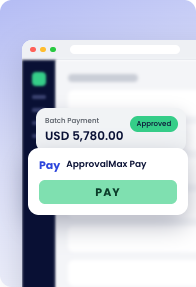
ApprovalMax Pay is available to UK businesses using Xero.
It supports local payments through Open Banking, and Wallets for payments in more than 30 currencies across 150+ countries, in batches of up to 200 payments.
For every other client, approval happens in ApprovalMax and payment happens in the client's bank or payment system. The separation between approval and payment then has to hold across both systems.
Where we would use something else
ApprovalMax is built around approval control. It is not a general payments platform, and it is not a practice management system.
You will need other software if the main requirement is:
- very high-volume global supplier payouts
- supplier tax onboarding and withholding across several jurisdictions
- corporate cards and employee expenses
- practice workflow and job management
- clients on an ERP other than NetSuite
A firm running AP for clients usually ends up with two or three systems rather than one product that does everything.
ApprovalMax for accountants and bookkeepers covers the practice features, and the ApprovalMax Partner Program covers partner setup, certification, support and discounts.
Free trial
See how ApprovalMax enforces approval controls automatically
No credit card required. Works with Xero, QuickBooks Online, and NetSuite.
Start free trial Book a demo
What this guide is based on
The recommendations on scope, onboarding, pricing and common AP problems are ours. They come from ApprovalMax's work building approval software for accounting and bookkeeping practices, alongside published research and competitor material on AP outsourcing. They are not the findings of an ApprovalMax study of its customer base.
External figures link to their original source and carry the relevant date. The CAS figures come from CPA.com and the AICPA's PCPS benchmark survey. Vendor figures, including our approval-speed data and Dext's extraction-accuracy figure, are identified as vendor-reported.
ApprovalMax product details were checked against our documentation in September 2026. Product features change, so anything that affects a buying decision should be checked again at the point of purchase.
We have not covered the legal or regulatory requirements of holding client payment authority. Those vary by country, professional body and insurer, so check the rules that apply to you.
Start with the boundary
The first client on an AP service runs on goodwill and a shared inbox. The fifth can't.
Write down what your firm does and what the client keeps. Leave spending approval and payment authority with the client unless you have agreed otherwise in writing. Keep your team's process the same from client to client, change the approval matrix where a client needs it changed, track the numbers that show how much work each account creates, and move the fee when the work moves.
A favour becomes a service the moment somebody writes down where it stops.
Frequently asked questions
What is accounts payable outsourcing?
Accounts payable outsourcing is when a business gives some or all of its day-to-day AP work to an external provider, such as an accounting firm or a business process outsourcer. It can include invoice capture, coding, matching, approval administration and payment preparation. Spending approval and payment authority normally stay with the business unless a different arrangement is agreed.
How much does it cost to outsource accounts payable?
Price depends on invoice volume, number of entities, approval complexity and how many invoices need manual work. Firms may charge a monthly fee per entity, use volume bands, charge by time, or combine several methods. Ask what workload the quoted price assumes, and what happens if volumes or complexity increase.







 Ask Perplexity