Accounts payable (AP) has undergone a fundamental transformation. What was once considered a back-office administrative function is now a primary strategic lever for managing cash flow, preventing sophisticated fraud, and driving operational efficiency in 2026. For US finance leaders, staying competitive means moving beyond basic digitization toward intelligent, integrated systems. This year, the focus shifts from merely capturing data to mastering the workflows that turn that data into financial intelligence. Here is what your finance team needs to know about the evolvingaccounts payable automation landscape.
Key Takeaways
AP is a strategic function now, not just back office admin. It drives cash flow, fraud prevention, and efficiency in 2026.
Approval is the bottleneck most teams ignore. ApprovalMax data shows 25% of invoices clear in under 2 hours, 50% within a day, when approval is intelligent.
Fraud has shifted to hijacked vendor details. ApprovalMax has seen a 300% rise in prospects asking for bank-account-change workflows in 2026.
66% of AP teams are still partially automated (IFOL). If approvals run on email or payments need bank-portal entry, there is real efficiency left to capture.
Pick two or three trends, not all eight. Fix process and team first. Tools come last.
The quick answer
In 2026, AP automation is defined by the shift from basic OCR tools to agentic AI, embedded payments, and centralizedaccounts payable controls that protect against AI-driven fraud.
Why 2026 is a pivotal year
Four converging forces make 2026 a turning point for finance departments. First, AI has finally matured past the pilot phase, offering reliable autonomous capabilities for the first time. Second, fraud has reached record levels of sophistication; according to the AFP 2025 Payments Fraud and Control Survey, 79% of organizations experienced attempted or actual payments fraud in 2024. Third, a wave of global e-invoicing mandates is going live, impacting any US business with international operations. Finally, the acute shortage of finance talent in the US persists, making automation the only viable way to scale without adding headcount. Strengthening yourfinancial controls is no longer optional.
8 accounts payable automation trends to watch in 2026
1
AI-powered touchless invoice processing becomes the default
Touchless processing occurs when an invoice is captured, coded, matched, and routed for approval with zero human intervention. While many teams previously relied on manual data entry, 2026 marks the year when touchless flows become the standard expectation for mid-market businesses. For finance teams, this means significantly faster payment cycles and the elimination of "fat-finger" errors. FollowingAP automation best practices allows staff to pivot from data entry to high-value analysis.
2
Agentic AI moves from pilot to production
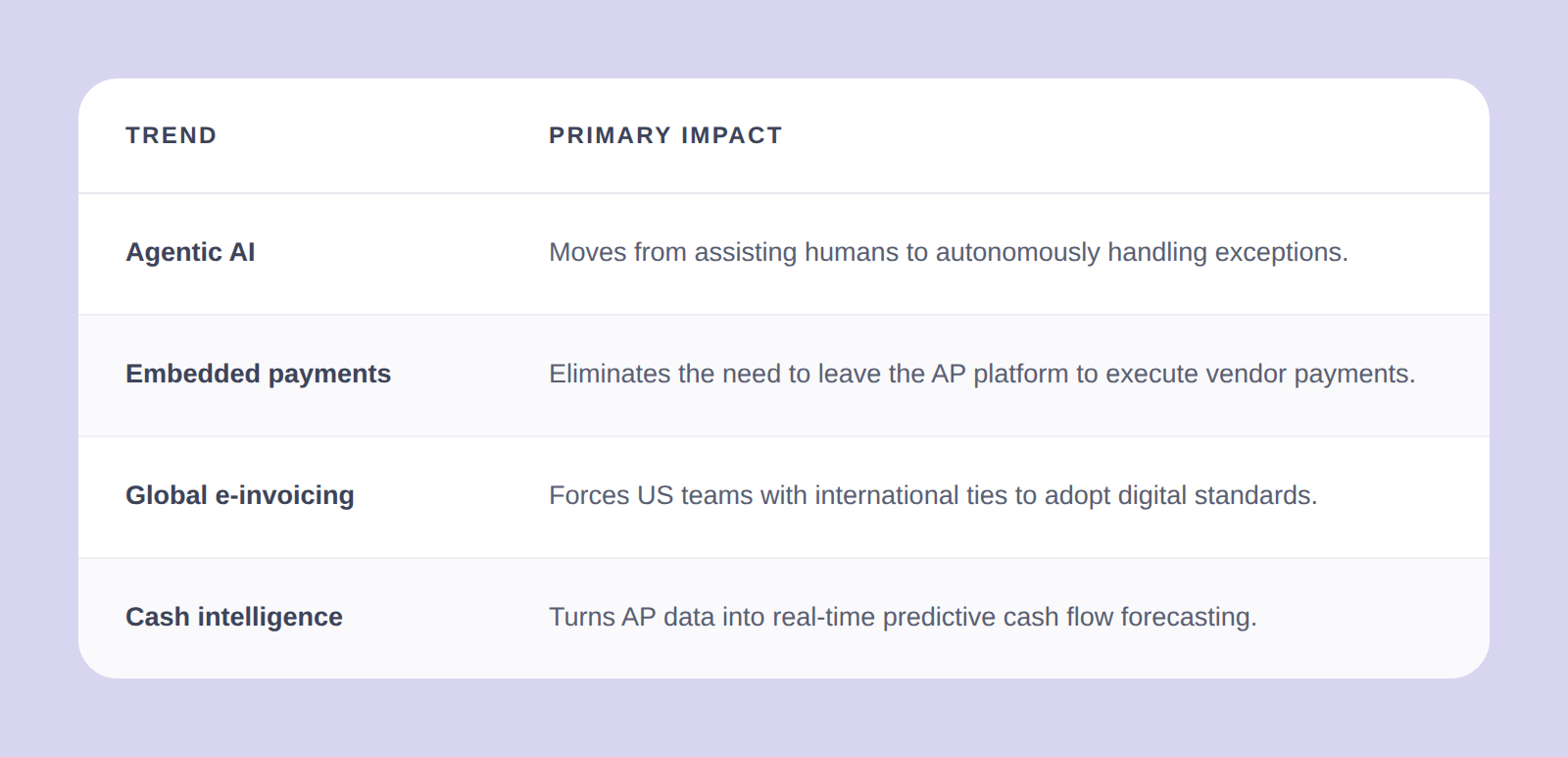
Agentic AI differs from traditional AI because it takes independent actions within set guardrails rather than just assisting a user. While AI-assist requires a human to drive, agentic AI can independently resolve minor exceptions, communicate with suppliers about missing info, and flag potential fraud. Meng Liu, Senior Analyst at Forrester, notes: "AI adoption in AP is no longer limited to data extraction or coding assistance. Vendors are now deploying agentic capabilities to support autonomous tasks such as exception handling, fraud detection, and supplier management." To succeed here, teams must first ensure they have establishedaccounts payable controls and clean data.
3
Approval workflow intelligence gets smarter
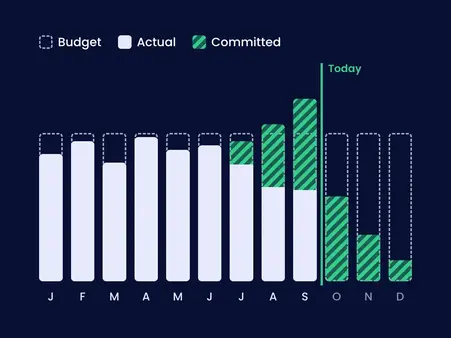
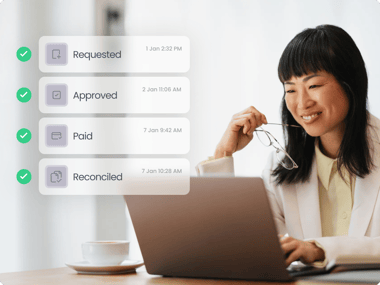
Most AP automation discussions fixate on capture and payment while ignoring the critical step in between: the approval. In 2026, an intelligentinvoice approval workflow routes documents automatically based on granular rules, department budgets, and vendor risk levels. These systems now include auto-substitution features to prevent bottlenecks when an approver is out of the office. Mobile approvals are now the default, and comprehensive audit trails are built directly into the process rather than added as an afterthought. Quarterly platform benchmarks from ApprovalMax (Q1 2026) show that 25% of all invoices are fully authorized in under two hours, and 50% are completed within 24 hours. For CFOs chasing early-payment discounts, that speed turns AP from a cost center into a margin lever.
Automated reminders and auto-substitution (where a backup approver steps in when the primary is unavailable) have reduced bottleneck duration by 40%, according to ApprovalMax internal analysis. The invoice no longer sits idle because someone is on a flight or on leave.
4
Embedded payments and virtual cards reshape supplier payment
The days of leaving your AP platform to log into a separate banking portal are ending. In 2026, payment execution is moving directly inside the AP platform through embedded finance. Virtual cards are gaining rapid adoption among US organizations because they are far more secure than traditional checks. These cards offer dynamic generation and strict spend limits, providing CFOs with a centralized, real-time view of all outgoing cash. Transitioning to these tools is a major step in moving toward apaperless accounts payable process.
5
Fraud prevention moves to the center of AP
Fraud prevention is no longer a side task for IT; it is now a core AP responsibility. Because AP manages the payment pipe, it is the highest-value attack surface for criminals using AI-generated business email compromise (BEC) and deepfake voice calls. The threat is also shifting in nature. ApprovalMax sales inquiry trends show a 300% increase in prospects specifically seeking "bank account change" workflows in 2026. Fraud is moving from fake invoices to hijacked vendor details, where a legitimate supplier's payment instructions are altered mid-stream. Automated bank-detail verification and segregation of duties for accounts payable are no longer nice-to-haves; they are the minimum.
To combat these 2026 threats, teams are implementing layered defenses, includingsegregation of duties for accounts payable, multi-factor authentication (MFA), and automated bank-detail verification. AI is simultaneously the source of new threats and a critical tool for detecting anomalies in real time.
6
Global e-invoicing mandates force US teams to adapt
While there is no US federal B2B mandate yet, US teams with European ties must adapt to international shifts. Belgium begins mandatory B2B e-invoicing on January 1, 2026, followed by Poland’s KSeF in February and April 2026, and France’s phased rollout starting in September 2026. Even domestically, federal procurement already requires electronic formats, and the DBNAlliance continues to build a voluntary US e-invoice exchange. Proactive teams are using anaccounts payable audit to ensure they are ready for these digital standards.
7
Supplier self-service portals become table stakes
Suppliers now expect a consumer-grade experience that lets them submit invoices and check payment status without emailing your team. This shift significantly reduces inbound inquiries and ensuresaccounts payable vendor management stays organized. In 2026, the bar for these portals includes 2FA for any bank detail changes and real-time status updates. This creates a more secure environment by ensuring that sensitive data changes flow through a verified workflow rather than an unencrypted email thread.
8
AP becomes a cash intelligence engine
In 2026, AP data is being used for predictive forecasting rather than just historical recordkeeping. Because AP captures liabilities before they reach the general ledger, it provides the most accurate view of future cash needs. Predictive models now help US mid-market CFOs anticipate seasonal spikes and identify early-payment discount opportunities. Given the current interest-rate environment, tracking theseaccounts payable KPIs is essential to maximize working-capital efficiency and protect the bottom line.
The partial automation gap: Why most teams still have work to do
Despite the headlines, the reality of AP in 2026 is that many teams remain stuck in a "partial automation" phase. While they may use OCR for capture, their approvals still happen over email, or their payments require manual entry into a bank portal. According to IFOL, 66% of AP teams still manually enter invoice data into ERP systems. If your team is in this category, there is a massive amount of efficiency left to capture by finding thebest accounts payable automation software to close these gaps.
Common AP automation pitfalls to avoid
Automating the wrong step first. Invoice capture is often the first focus, but approval delays are usually the primary bottleneck.
Picking tools that don't integrate. A tool that requires manual re-entry into QuickBooks Online or Xero creates a new data-entry problem.
Treating AI as a replacement for judgment. Agentic AI requires stable processes; piloting it on messy workflows often yields poor results.
Skipping vendor validation. Automating payments without bank-detail-change workflows and duplicate detection increases your fraud risk.
Underinvesting in AP team skills. Automation changes the nature of AP work from transactional to analytical, requiring updatedAP automation best practices and job descriptions.
How to act on these trends in 2026
Audit your current AP automation. Map out every step from capture to reporting to identify where manual friction still exists.
Close the approval gap first. This is the highest-impact, lowest-lift trend for 2026 and should be addressed before making large AI investments.
Layer fraud controls. Implement MFA, segregation of duties, and automated vendor validation immediately to protect your payments.
Pilot AI on one well-defined use case. Start with a narrow focus, like exception handling or cash forecasting, where the success criteria are clear.
Invest in your AP team, not just tools. Shift your team’s KPIs to focus on analytical outcomes rather than just invoice volume.
You do not need to act on all eight trends in 2026. Pick two or three.
How ApprovalMax fits the 2026 AP picture
ApprovalMax provides the criticalapproval workflows layer that is often the missing piece in a partially automated AP process. While many tools focus solely on capture or payment, we ensure that every invoice is verified, authorized, and compliant before a single dollar leaves the company. Our platform provides the intelligence needed to route invoices based on real-time budgets and vendor risk, all while maintaining a bulletproof audit trail for QBO and Xero users.
A typical mid-market services firm using ApprovalMax recaptures 180 hours of finance-team time per month, shifting staff from signature chasing to cash flow analysis. That is the ROI of control: not just faster processing, but a fundamentally different use of your finance team's time.By centralizing the approval process, we help finance teams implement the fraud controls and workflow intelligence required in 2026. Internal analysis of over 20,000 global financial entities on the ApprovalMax platform confirms the pattern: teams that centralize approval logic see fewer exceptions, cleaner ledgers, and shorter audit cycles.
FAQs
What is agentic AI in accounts payable?
Agentic AI describes AI that takes independent actions inside set guardrails, not just suggestions. In AP, that means handling exceptions, chasing missing supplier info, and flagging fraud without a human starting each task. It works only when processes and data are clean enough for the AI to operate safely on its own.
What is touchless invoice processing?
Touchless processing is when an invoice is captured, coded, matched, and routed for approval with zero manual steps. The AP team only sees the invoice if something is off. It is the standard expectation for mid-market teams in 2026 and the foundation most other AP automation trends build on.
Do small businesses need AP automation, or is it just for enterprises?
Small businesses benefit the most. Enterprises absorb manual AP work across large teams; small businesses cannot. For a 5 to 50 person finance setup on QuickBooks Online or Xero, automation closes the gap between limited headcount and rising invoice volume, and prevents fraud that hits smaller teams hardest.
How do I know if my AP team is ready to automate?
Run a quick check: Is every invoice captured into one system? Is your approval workflow documented? Are your capture, approval, and payment tools connected? Is your vendor master data clean? Does someone own the AP process end-to-end? If you answered yes to four or more, you are ready. If two or fewer, fix the process before adding tools.
ApprovalMax is a trusted Xero, Quickbooks and NetSuite partner who helps finance teams implement structured approval workflows and financial controls across the entire Money Out lifecycle - not just at the point of payment.







 Ask Perplexity